 Advanced Search
 Map View
 About Us
 News
News
 Contact
 Bildirimde Bulun






 Login
Login

Data and Information System


Invasive Species Details
Monk Parakeet
| Kingdom | Phylum | Class | Order | Family | Genus and species |
|---|---|---|---|---|---|
| Animalia | Chordata | Aves | Psittaciformes | Psittacidae | Myiopsitta monachus |
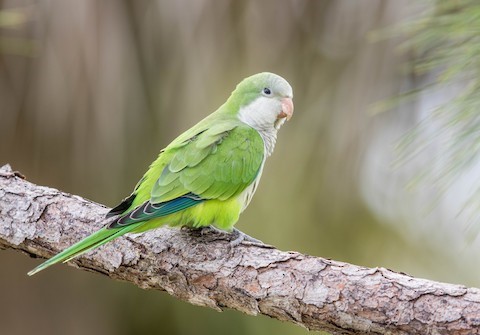
Monk Parakeet
"Myiopsitta monachus monachus (Boddaert, 1783) Myiopsitta monachus cotorra (Vieillot, 1818) Myiopsitta monachus calita (Jardine & Selby, 1830)"
It is a medium-sized parrot, measuring 29 cm in length, with a wingspan of 53 cm, and weighing 90-120 grams. The forehead, face, throat, neck, and chest are gray. The crown, nape, back, rump, and tail are green. The wings are dark green, with outer wing coverts and primary coverts being blue. The tail is long and graduated. The beak is thick, short, and yellowish-brown. The beak tip is blunt. The iris is dark brown. The legs are gray. Males and females have the same appearance (Kolar and Spitzer, 1990; Burgio et al., 2020). Myiopsitta monachus prefers open areas. In its native areas, it can be found in wooded areas in savannas, farms, plantation areas, gardens, and planted forests. It can be seen at altitudes up to 1600 meters above sea level. In areas where it has invaded, it is found in wooded areas in cities and parks (Minor et al., 2012). In its natural habitats, the Monk Parakeet is considered an agricultural pest. It damages fruit orchards and agricultural crops. Additionally, it has been reported to cause power outages by colliding with power lines where breeding birds nest. In areas where it is invasive, its effects are generally related to nest behavior. It has been traded as a caged bird since the 1960s due to its beauty and intelligence (Campbell, 2000). Its natural distribution area includes the low areas of the Andes Mountains in subtropical and temperate South America, Bolivia, Paraguay, Uruguay, southern Brazil, and southern Patagonia (Campbell, 2000; IUCN, 2020). It is a species that is heavily traded as a pet and is covered by CITES. Approximately 65,000 Monk Parakeets were imported to America between 1968 and 1972 (Spreyer and Bucher, 1998). According to CITES records, the first and only record of Monk Parakeet observed in the wild in Turkey is from March 2020 in Istanbul.
Type Description
It is a medium-sized parrot, measuring 29 cm in length, with a wingspan of 53 cm, and weighing 90-120 grams. The forehead, face, throat, neck, and chest are gray. The crown, nape, back, rump, and tail are green. The wings are dark green, with outer wing coverts and primary coverts being blue. The tail is long and graduated. The beak is thick, short, and yellowish-brown. The beak tip is blunt. The iris is dark brown. The legs are gray. Males and females have the same appearance (Kolar and Spitzer, 1990; Burgio et al., 2020).
Habitat
"Myiopsitta monachus prefers open areas. In its native regions, it can be found in wooded areas in savannas, farms, plantations, gardens, and planted forests. It can be seen at altitudes of up to 1600 meters above sea level. In areas where it has invaded, it is found in wooded areas in cities and parks (Minor et al., 2012). Its natural distribution area includes the lowlands of the Andes Mountains in subtropical and temperate South America, Bolivia, Paraguay, Uruguay, southern Brazil, and southern Patagonia (Campbell, 2000; IUCN, 2020).
Areas outside its natural distribution: Eastern United States, Southern Canada, Spain, Italy, France, Belgium, Germany, Austria, the Netherlands, the Czech Republic, Kenya, Japan, Bermuda, Puerto Rico, Bahamas, and England (Campbell, 2000).
In Turkey, only records from Istanbul are known. Other records of Monk Parakeets have also been reported, which are reported to be escapees from captivity, first observed as a pair in March 2020."
Reproductive Information
"It is monogamous. The courtship behavior lasts for a very short time. Mating occurs in the nest. In North America, mating is observed in the spring, from mid-April to late June (Hyman and Pruett-Jones, 1995). In South America, courtship and mating have been observed in October (Martella, 1985). Nest building and repair generally occur in the summer and spring. In North America, egg laying occurs from April to July. In South America, egg laying occurs in November and December. In captivity, they breed 2-3 times a year, but in the wild, they breed 1-2 times. They build their nests on natural or artificial structures, preferring trees such as Fraxinus pennsylvanica, Picea abies, Abies sp., Phoenix sp., as well as electric and telephone poles. Their nests, built in high places, have one or more entrances (Hyman and Pruett-Jones, 1995).
In North America, the clutch size is an average of 4.9 eggs in nests with a single entrance, and an average of 5.6 eggs in nests with multiple entrances. In South America, the clutch size is an average of 5-7 eggs in the first breeding, and 8-12 eggs in subsequent breedings (Avery et al., 2012).
After laying the first egg, females immediately start incubating. Males do not incubate. During incubation, the male brings food to the female. The incubation period is 25-28 days (Eberhard, 1998). The approximate fledging period for a hatched chick is 35-40 days (Navarro and Bucher, 1990). Both sexes participate in chick rearing."
Lifecycle
"The life cycle stages differ significantly between the Northern and Southern Hemispheres. The Monk Parakeet is not migratory in either location. In Argentina, breeding activities occur from early October to late December. Chick rearing takes place from mid-November to mid-February. Molting generally occurs from December to mid-June.
In Florida, breeding activities occur from early October to late December. Chick rearing takes place from mid-April to mid-July. Molting generally occurs from April to mid-October."
Nutrition Information
Primarily, it feeds on seeds, leaf buds, fruits, nuts, and flowers. Occasionally, it also feeds on insects and their larvae. In South America, it feeds on seeds of Asteraceae and Poaceae, fruits of palms and some native trees, as well as seeds of species like Celtis spinosa, Triticum sp., Helianthus sp., Zea mays, Oryza sativa, and Sorghum vulgare.
General Impact Information
In the areas where they are native, Monk Parakeets are considered agricultural pests, causing damage to orchards and agricultural crops. Additionally, collisions of breeding birds with power lines have been reported, leading to power outages. In invaded areas, their effects are generally associated with nesting behavior. Monk Parakeets build large nests on electric and telephone poles, which can lead to power outages and even fires, especially during rainy periods. This is a frequently reported problem with significant economic costs. In South Florida, for example, during a 5-month period in 2001, Monk Parakeets caused a total of 198 power outages, resulting in an estimated loss of $24,000 in electricity sales and $221,000 in repair costs. However, there are no reports of Monk Parakeets competing with other species or causing damage as an invader.
General Management Information
"Prevention Measures: In the United States, due to the rapid increase in their numbers, an eradication program was initiated in 1973. Killed Monk Parakeets in New York, New Jersey, Virginia, and California accounted for approximately 87% of the existing Monk Parakeets. Except for California, these states did not develop any control and management mechanisms. California remained the only state to continue to control the species and imposed restrictions on the importation, transportation, and possession of Monk Parakeets, requiring special permits (Spreyer and Bucher, 1998).
Chile implemented a ban on the species in 1997 due to the increase in numbers since 1972. There is no comprehensive management for the entire United States, only various restriction measures taken at the state level (Newman et al., 2004).
The Australian Bureau of Rural Sciences conducted a risk assessment study and established a basis for evaluating applications for the importation of exotic species. Three risk categories were defined to classify an exotic species into a danger category: 1- escaped or released birds may harm humans, 2- escaped or released birds may establish wild populations in nature, 3- if such species can establish a wild population, they may be harmful. These three criteria are graded in extreme, serious, moderate, and low categories. The Monk Parakeet was classified as ""extreme"" for Australia based on all these categories, hence it is not allowed to be imported or owned in the country (Bomford, 2003).
Physical: Because Monk Parakeets caused significant damage to longan orchards, some measures were taken such as hanging carcasses and reflective objects on trees to keep the birds away. Other effective and recommended measures include stretching nets around areas to keep parrots away and applying some deterrents to prevent nest building. Currently, preventing nest construction and removal from the area through capture are the most feasible methods (Newman et al., 2004).
Chemical: In South America, it has been found that organophosphate-containing pesticides such as Azodrin and Carbofuran kill individuals when sprayed at the entrance of nests. However, such methods can also be risky for non-target species (Spreyer and Bucher, 1998).
For the control and management of Monk Parakeets, integrated practices such as destruction of nest sites and capture of the species should be carried out together to achieve success."
General Pathway Information
"This species is heavily traded in the pet trade and is listed under CITES. Approximately 65,000 Monk Parakeets were imported to America between 1968 and 1972 (Spreyer and Bucher, 1998). They have been observed outside their natural range due to the pet trade.
According to CITES records, the first and only recorded sighting of Monk Parakeets in the wild in Turkey since 2005 was in March 2020 in Istanbul. These observations recorded a pair of Monk Parakeets, reported to be escaped from captivity. Monk Parakeets are commonly sold in pet shops and online. In recent years, there has been an increase in the number of Monk Parakeets imported through official channels (200 in 2017, 470 in 2018, 310 in 2019), so it is thought that they may be more frequently observed in the wild as a result of intentional or accidental releases. It is important to monitor the observed individuals."
Notes
It has been traded as a cage bird since the 1960s. It is highly preferred for its beauty and intelligence (Campbell, 2000).
References
LOCATIONS
IMPACT INFORMATION
"Doğal olarak bulunduğu alanlarda Keşiş papağanı tarım zararlısı olarak değerlendirilmektedir. Meyve bahçelerine ve tarımsal ürünlere zarar vermektedir. Ayrıca üreyen kuşların elektrik tellerine çarpması ile elektrik kesintilerine sebep oldukları bildirilmiştir. İstilacı olduğu bölgelerde ise genellikle etkileri yuva davranışları ile ilişkili olarak verilmektedir. Keşiş papağanları elektrik ve telefon direkleri üzerine oldukça büyük yuvalar yapmaktadır. Elektrik direklerinde yuvalar elektrik kesintilerine, yangınlara neden olabilmektedir. Özellikle yağışlı zamanlarda sıklıkla bildirilen bir problemdir. Elektrik kesintisi, elektrik malzemelerinde hasar gibi ekonomik kayıplara neden olabilir (Newman vd., 2004). Maliyeti konusunda çeşitli beyanlar olsa da Güney Florida’da 2001 yılında 5 aylık bir sürede Keşiş papağanları toplam 198 elektrik kesintisine neden olmuştur. Bununla ilişkili olarak elektrik satımı ile ilgili kayıp 24.000 Dolar, tamirat için yapılan harcamalar ise 221.000 Dolar olarak hesaplanmıştır (Newman vd., 2004).
İstilacı olduğu alanlarda ne tarım zararlısı olarak ne de başka türlerle rekabet ettiği raporlanmıştır.
"
MANAGEMENT INFORMATION
"Prevention Measures: In the United States, due to the rapid increase in their numbers, an eradication program was initiated in 1973. Killed Monk Parakeets in New York, New Jersey, Virginia, and California accounted for approximately 87% of the existing Monk Parakeets. Except for California, these states did not develop any control and management mechanisms. California remained the only state to continue to control the species and imposed restrictions on the importation, transportation, and possession of Monk Parakeets, requiring special permits (Spreyer and Bucher, 1998).
Chile implemented a ban on the species in 1997 due to the increase in numbers since 1972. There is no comprehensive management for the entire United States, only various restriction measures taken at the state level (Newman et al., 2004).
The Australian Bureau of Rural Sciences conducted a risk assessment study and established a basis for evaluating applications for the importation of exotic species. Three risk categories were defined to classify an exotic species into a danger category: 1- escaped or released birds may harm humans, 2- escaped or released birds may establish wild populations in nature, 3- if such species can establish a wild population, they may be harmful. These three criteria are graded in extreme, serious, moderate, and low categories. The Monk Parakeet was classified as ""extreme"" for Australia based on all these categories, hence it is not allowed to be imported or owned in the country (Bomford, 2003).
Physical: Because Monk Parakeets caused significant damage to longan orchards, some measures were taken such as hanging carcasses and reflective objects on trees to keep the birds away. Other effective and recommended measures include stretching nets around areas to keep parrots away and applying some deterrents to prevent nest building. Currently, preventing nest construction and removal from the area through capture are the most feasible methods (Newman et al., 2004).
Chemical: In South America, it has been found that organophosphate-containing pesticides such as Azodrin and Carbofuran kill individuals when sprayed at the entrance of nests. However, such methods can also be risky for non-target species (Spreyer and Bucher, 1998).
For the control and management of Monk Parakeets, integrated practices such as destruction of nest sites and capture of the species should be carried out together to achieve success."