 Advanced Search
 Map View
 About Us
 News
News
 Contact
 Bildirimde Bulun






 Login
Login

Data and Information System


Invasive Species Details
Ruddy Duck
| Kingdom | Phylum | Class | Order | Family | Genus and species |
|---|---|---|---|---|---|
| Animalia | Chordata | Aves | Anseriformes | Anatidae | Oxyura jamaicensis |
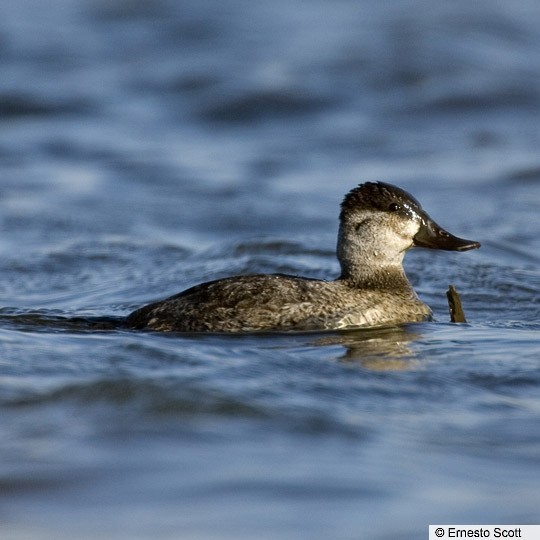
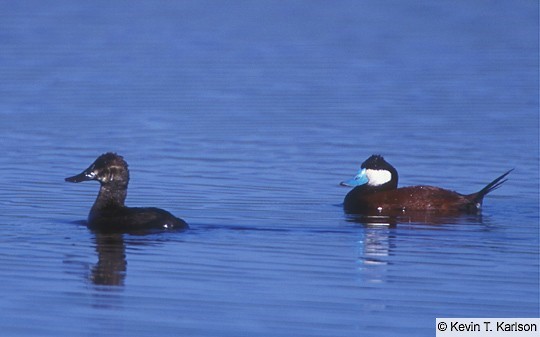
Ruddy Duck
Monotipiktir. Bazı kaynaklar 2 ya da 3 alttürü olduğunu belirtse de güncel kaynaklar alttür vermemektedir (Brua, 2020).
The male is 37-43 cm in length, while the female is 35-41 cm. The female weighs an average of 550 grams, while the male weighs an average of 600 grams. The wingspan is 460-470 mm. It is a short and round-bodied, with an upright tail. The neck is not visible. Adult males have a reddish-brown body and wings. The crown, nape, and neck are black. The cheeks and forehead are white. The short tail is black, and it is held upright. Its light blue bill is distinctive. The female is brownish-grey. The crown and nape are dark brown, and there is a dark cheek stripe running from the bill to the nape on a dirty white cheek. The bill color is brownish in females. They are found in reed beds, lakes, ponds, various water reservoirs, freshwater, and saline lakes. They can be found in almost all wetlands with the necessary water surface for takeoff and landing. During breeding season, they prefer reed beds of approximately 0.4-4 hectares. Oxyura jamaicensis competes with the globally endangered White-headed Duck (Oxyura leucocephala) and threatens it by mating and hybridizing with it. In captivity, hybrids between the Ruddy Duck and the White-headed Duck have been shown to produce fertile offspring in the first generation, further increasing the threat to the White-headed Duck. The accidental release from private collections or zoos is the way this species enters natural areas (Hudson, 1976). The Ruddy Duck feeds on aquatic insects, crustaceans, zooplankton, and other invertebrates. Most studies have shown that it feeds primarily on Chironomid larvae. They also consume small amounts of aquatic plants and seeds, with the seeds of Ruppia occidentalis being the most commonly recorded plant food. They feed by diving and can dive to a depth of about 1.5 m (Siegfried, 1973; Tome and Wrubleski, 1988).
Type Description
"The male is 37-43 cm, while the female is 35-41 cm in length. The female weighs an average of 550 grams, while the male weighs an average of 600 grams. The wingspan is 460-470 mm. It is a short and round-bodied diving duck with an upright tail. The neck is not visible. Adult males have a reddish-brown body and wings. The crown, nape, and neck are black. The cheeks and forehead are white. The short tail is black, and it is held upright. Its light blue bill is distinctive. The female is brownish-grey. The crown and nape are dark brown, and there is a dark cheek stripe running from the bill to the nape on a dirty white cheek. The bill color is brownish in females.
It is distinguished from the White-headed Duck by being smaller, not having a bulging bill, having a thinner cheek stripe, and having more black on the crown and nape."
Habitat
They are found in marshy areas, lakes, ponds, various water reservoirs, freshwater, and saline lakes. They can be found in almost all wetlands with the necessary water surface for take-off and landing. During the breeding season, they prefer marshy areas of approximately 0.4-4 hectares in size. Normally, they are distributed in North America, the Caribbean, and the Antilles in South America. However, they are invasive in Europe, especially in the United Kingdom, France, Belgium, and the Netherlands, where significant populations exist. Eradication began in France in 2005, and its distribution in this country has become more fragmented. In other European countries, it has been detected in very low numbers. Various records have been reported from Turkey. Observations that are sometimes thought to be hybrids are reported. However, since these cannot be considered as "confirmed records," not all of them have been recorded. There are records of the White-headed Duck or hybrids that are most likely correct from areas such as Lake Büyükçekmece and Lake Uyuz, but they remain a subject of debate (Kirwan et al., 2008; CABI, 2020).
Reproductive Information
They are monogamous. Pairing occurs during a breeding season. Unlike many other ducks, mating occurs shortly after reaching the breeding grounds. Females build nests 3-5 weeks after arriving at the breeding ground. Nest construction is usually completed during egg laying. Although the breeding season varies regionally, it generally occurs between April and August. Clutch size ranges from 6-10 eggs. The incubation period is recorded as 23-26 days. Both sexes, but mostly females, incubate the eggs. Incubation marks are not observed in breeding White-headed Ducks. The young can leave the nest under parental supervision one day after hatching. The parents leave the nest when the young are 20-30 days old. The juveniles can leave the nest completely 50-55 days after hatching. Their lifespan is approximately 13 years (Brua, 2020).
Lifecycle
The migration period lasts from late March to late May and from late August to late November. Breeding occurs from mid-March to early September. The molting period is in August and March (Brua, 2020).
Nutrition Information
The Ruddy Duck feeds on aquatic insects, crustaceans, zooplankton, and other invertebrates. Most studies have shown that it feeds primarily on Chironomid larvae. It also consumes small amounts of aquatic plants and seeds. Among the plant foods, seeds of Ruppia occidentalis are most commonly recorded. They feed by diving, reaching depths of approximately 1.5 meters (Siegfried, 1973; Tome and Wrubleski, 1988).
General Impact Information
"Oxyura jamaicensis, known to compete and hybridize with the globally threatened White-headed Duck (Oxyura leucocephala), poses a threat to the White-headed Duck species. It has been found that hybrids in captivity, particularly the first generation of Ruddy Duck x White-headed Duck hybrids, can produce fertile offspring. This situation further increases the threat to the White-headed Duck species.
Oxyura jamaicensis is also known to be in competition with other waterbirds that share similar habitats, such as the Little Grebe (Tachybaptus ruficollis) and the Black-necked Grebe (Podiceps nigricollis), due to its aggressive behavior. It is considered a species that significantly affects biodiversity (Hughes, 1996).
Risk and impact factors of the Ruddy Duck species:
Invasiveness:
It has been identified as invasive in areas where it is not naturally found.
The native population has a wide distribution.
The native population is abundant in distribution areas.
It can consume a wide variety of foods.
It is highly mobile.
It has a long lifespan.
It is migratory.
Impact consequences:
Changes in gene pool and genotype.
Threatening/loss of species at risk.
Threatening/loss of native species.
Impact mechanisms:
Hybridization.
Entry and control probability:
Control is difficult and costly."
General Management Information
"The management of the species refers to the control and eradication of alien species, with reference to EU agreements. These agreements include:
EU Directive (79/409/EEC) on the Conservation of Wild Birds (Birds Directive)
EU Directive (92/43/EEC) on the Conservation of Natural Habitats and of Wild Fauna and Flora (Habitats Directive)
Convention on Biological Diversity (Biodiversity Convention)
Convention on the Conservation of European Wildlife and Natural Habitats (Bern Convention)
Convention on Migratory Species of Wild Animals (CMS)
African-Eurasian Migratory Waterbird Agreement (AEWA)
Convention on International Trade in Endangered Species of Wild Fauna and Flora (CITES)
In 2003, the Ruddy Duck was included in CITES and its trade was restricted. Additionally, CMS, AEWA, and EU agreements added a clause stating ""there is no competition for nesting sites and food sources for the Ruddy Duck,"" setting a target for the ""eradication of the Ruddy Duck from Europe by 2015."" Some of the Ruddy Ducks reported in Europe have been shot. While significant progress has been made in eradication efforts, there has been no development regarding the situation of captive species (Cranswick and Hall, 2010)."
General Pathway Information
"Collectors or escapes from zoos are the accidental entry pathways for the species to enter outside their natural range (Hudson, 1976). Originally from North America, this species was first brought to England in the 1950s for personal collections. By 2002, the species had spread widely in Europe, reaching over 20 countries and increasing its numbers to around 6000. Individuals believed to be seen in Turkey are visitors from these countries. It is not a bird kept in captivity or in parks in our country.
Various records have been reported from Turkey. Observations sometimes thought to be hybrids are reported, but since they cannot be considered as ""confirmed records,"" not all of them have been recorded. There are records of Ruddy Ducks or hybrids from locations such as Lake Büyükçekmece and Lake Uyuz, which are likely to be correct (Kirwan et al., 2008; CABI, 2020). These records have been accepted as correct on the BirdLife, IUCN, CABI, ISSG websites and have been included among the countries where the species is distributed. It is known that the species forms hybrids with the globally endangered White-headed Duck (Oxyura leucocephala) in Spain, Portugal, and France. Therefore, the status and numbers of the species in every area where it is seen, including suspicious records, should be monitored."
Notes
Occasionally, suspicious records are reported in Turkey. Observations regarding these records should be carefully examined. If the species is observed in Turkey for a long period, monitoring should be conducted and measures should be taken to ensure the eradication of the species.
References
LOCATIONS
IMPACT INFORMATION
"Oxyura jamaicensis, nesli küresel ölçekte tehlike altında olan Dikkuyruk (Oxyura leucocephala) türü ile rekabet etmesi ve çiftleşerek hibritleşmesi ile Dikkuyruk türünü tehdit etmektedir. Esaret altındaki melezlerde, Karabaşlı dikkuyruk x Dikkuyruk melezlerinin ilk neslinin verimli döller oluşturabildiği tespit edilmiştir. Bu durum Dikkuyruk üzerindeki tehdidi daha da arttırmaktadır.
Oxyura jamaicensis, benzer alanlar paylaştığı Küçük batağan (Tachybaptus ruficollis) ve Karaboyunlu batağan (Podiceps nigricollis) gibi sukuşları ile agresif davranışları sonucunda rekabet halinde olduğu bilinmektedir. Biyoçeşitliliği önemli derece etkileyen bir tür olarak kabul edilmektedir (Hughes, 1996).
Karabaşlı Dikkuyruk türünün risk ve etki faktörleri:
İstilacılık:
- Doğal olarak bulunmadığı alanlarda istilacı olduğu tespit edilmiştir.
- Yerli popülasyonun geniş bir dağılımı vardır.
- Yerli popülasyon dağılım alanında boldur.
- Çok çeşitli besinleri tüketebilir.
- Oldukça hareketlidir.
- Uzun bir ömrü vardır.
- Sürücüldür.
Etki sonuçları:
- Gen havuzunda ve genotipte değişiklik.
- Nesli tehlike altında olan türleri tehdit etme/kaybına neden olma
- Yerli türleri tehdit etme/kaybına neden olma
Etki mekanizmaları:
- Hibritleşme.
Giriş ve kontrol olasılığı
- Zor ve maliyetli kontrol
"
MANAGEMENT INFORMATION
"The management of the species refers to the control and eradication of alien species, with reference to EU agreements. These agreements include:
EU Directive (79/409/EEC) on the Conservation of Wild Birds (Birds Directive)
EU Directive (92/43/EEC) on the Conservation of Natural Habitats and of Wild Fauna and Flora (Habitats Directive)
Convention on Biological Diversity (Biodiversity Convention)
Convention on the Conservation of European Wildlife and Natural Habitats (Bern Convention)
Convention on Migratory Species of Wild Animals (CMS)
African-Eurasian Migratory Waterbird Agreement (AEWA)
Convention on International Trade in Endangered Species of Wild Fauna and Flora (CITES)
In 2003, the Ruddy Duck was included in CITES and its trade was restricted. Additionally, CMS, AEWA, and EU agreements added a clause stating ""there is no competition for nesting sites and food sources for the Ruddy Duck,"" setting a target for the ""eradication of the Ruddy Duck from Europe by 2015."" Some of the Ruddy Ducks reported in Europe have been shot. While significant progress has been made in eradication efforts, there has been no development regarding the situation of captive species (Cranswick and Hall, 2010)."