 Advanced Search
 Map View
 About Us
 News
News
 Contact
 Bildirimde Bulun






 Login
Login

Data and Information System


Invasive Species Details
Summer lilac, butterfly-bush, orange eye
| Kingdom | Phylum | Class | Order | Family | Genus and species |
|---|---|---|---|---|---|
| Plantae | Spermatophyta | Dicotyledonae | Gentianales | Loganiaceae | Buddleja davidii Franch. |
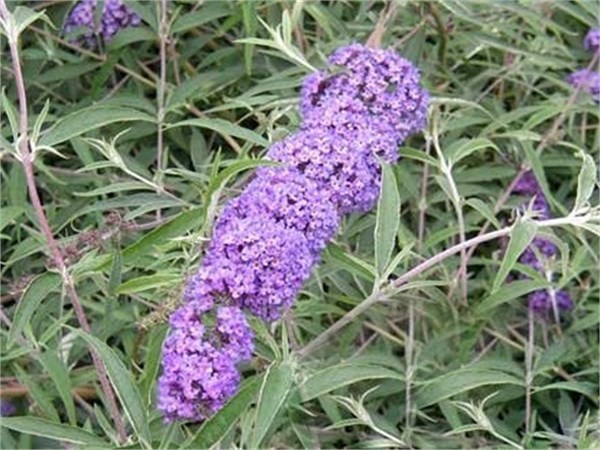
Summer lilac, butterfly-bush, orange eye
Buddleja davidii var. alba Rehder & E.H.Wilson, Buddleja davidii var. glabrescens Gagnep., Buddleja davidii var. magnifera Rehder & E.H.Wilson, Buddleja davidii var. nanhoensis (Chitt.) Rehder, Buddleja davidii var. superba Rehder & E.H.Wilson, Buddleja davidii var. veitchiana (J.H. Veitch) Rehder & Bailey, Buddleja davidii var. wilsonii Rehder & E.H.Wilson (TPL, 2020).
Its origin is China. It is a shrub that can grow up to 5 m tall. Although it is widely cultivated as an ornamental plant in parks and gardens, it can escape into natural areas, ranging from sea level to over 1000 m altitude. In its spread, it generally prefers moist areas along riverbanks or streams. It easily spreads to areas such as shrubs, untended areas along forest roads, areas disturbed by humans, urban open and vacant areas, riverbank corridors, quarries, cultivated areas, open forests, and transportation corridors (Sarı, 2019). In the Eastern Black Sea Region, especially in the Değirmendere Basin (Trabzon) and Altındere Valley National Park, and in the Eastern Anatolia Region along the Aras River (Erzurum), it has dense populations in stream vegetation. In the areas where it spreads, it can quickly form dense populations, cutting off the light of native plants in that area and causing harm by competing for water and nutrients.
Type Description
Its origin is China. It is a shrub that can grow up to 5 m tall. In years when winters are not very harsh, it exhibits a semi-evergreen behavior (Tallent-Halsell and Watt, 2009). Young shoots, lower leaf surfaces, flower clusters, and leaf stalks are abundantly covered with star-shaped hairs. The shoots are almost quadrangular. Stipules are mostly present. The length of the leaf stalk can be up to 0.5 cm, the leaves are narrowly ovate or narrowly elliptic, toothed margins, acute apex, and 9-14 pairs of lateral veins. The flower clusters are located at the shoot tip and can be up to 30 cm long. Flowers are violet or dark purple, rarely white. Capsule fruits are brown, narrowly elliptic, glabrous, or rarely starry hairy (Cao, 1996). Its life form is a shrub.
Habitat
It is widely cultivated as an ornamental plant in parks and gardens, but it can escape into natural areas, ranging from sea level to over 1000 m altitude. In its spread, it generally prefers moist areas along riverbanks or streams. It easily spreads to areas such as shrubs, untended areas along forest roads, areas disturbed by humans, urban open and vacant areas, riverbank corridors, quarries, cultivated areas, open forests, and transportation corridors (Sarı, 2019). In the Eastern Black Sea Region, especially in the Değirmendere Basin (Trabzon) and Altındere Valley National Park, and in the Eastern Anatolia Region along the Aras River (Erzurum), it has dense populations in stream vegetation. It naturally spreads in Central and Southwest China up to elevations of 3500 m. Moreover, it has spread widely in a large area including Europe (1896), after Europe to America, Australia, New Zealand, and North Africa as an ornamental plant. It has naturalized in most Central European countries and Australia (Sarı, 2019).
Reproductive Information
Lifecycle
Nutrition Information
General Impact Information
It can quickly form dense populations in the areas where it spreads, cutting off the light of native plants in that area and causing harm by competing for water and nutrients. Considering the elevations of its spread, it is considered that it may also harm endemic and rare plants.
General Management Information
General Pathway Information
The plant can produce several million seeds per year. The spread of small seeds primarily occurs through the wind. In its spread along riverbanks, especially rivers and streams are effective in the spread of the species. On the other hand, humans and various transportation vehicles are also important. The species was brought to our country as an ornamental plant. In other words, the primary vector is humans. Then, it expanded its distribution area in our country through wind and rivers. Considering the terminology used internationally, it was deliberately brought to our country (as an ornamental plant).
Notes
The species' high ecological tolerance contributes significantly to its popularity as an ornamental plant, while its naturalization along riverbanks also contributes significantly to its spread. Especially from the upper basin sections to the lower sections, it can easily be transported by rivers and valley winds, thus increasing its spread rate. The species is widely used and cultivated as an ornamental plant. Additionally, it is also used for medicinal purposes (Cao, 1996).
References
LOCATIONS
Seas or cities with distribution records for Summer lilac, butterfly-bush, orange eye
IMPACT INFORMATION
Yayıldığı alanlarda kısa sürede yoğun popülasyonlar oluşturarak o alandaki doğal bitkilerin ışığını keserek, su ve besinlerine ortak olarak zararlar oluşturabilmektedir. Yayılış yükseltileri dikkate alındığında kimi endemik ve ender bitkilere de zarar verebileceği değerlendirilmektedir.
- Damage to agriculture
MANAGEMENT INFORMATION