 Advanced Search
 Map View
 About Us
 News
News
 Contact
 Bildirimde Bulun






 Login
Login

Data and Information System


Invasive Species Details
Devil's Beggar Ticks
| Kingdom | Phylum | Class | Order | Family | Genus and species |
|---|---|---|---|---|---|
| Plantae | Spermatophyta | Dicotyledonae | Asterales | Asteraceae | Bidens frondosa L. |
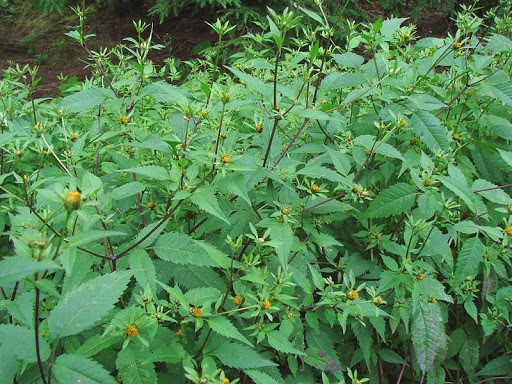
Devil's Beggar Ticks
Bidens frondosa var. anomala Porter ex Fernald, Bidens frondosa var. caudata Sherff, Bidens frondosa f. frondosa, Bidens frondosa var. frondosa, Bidens frondosa var. minor Hook., Bidens frondosa var. pallida (Wiegand) Wiegand, Bidens frondosa var. puberula Wiegand, Bidens frondosa var. stenodonta Fernald & H.St. John (TPL, 2020).
It is native to North America. It is an annual, 20-200 (280) cm tall, upright growing, taprooted plant. The species can live in many different ecosystems. The plant, which is a problem in agricultural areas, can also be found in a wide variety of habitats such as roadsides, around lakes and ponds, in forested areas, meadows, marshy areas and edges, ditches, drainage and waterways. It can also easily invade human-created habitats such as areas where urban waste is collected, harbors and docks, and debris fields. The plant prefers sunny or partially shaded areas and loamy nutrient-rich moist soils. The plant has low salt tolerance (Tad et al., 2015). In irrigated areas or areas with high rainfall, it can also damage other crops, especially paddy. Thanks to its seeds with high viability and germination ability, it spreads rapidly and can be easily socialized. Since it has allelopathic properties (Wang et al., 2014), it can negatively affect natural and agricultural plants.
Type Description
It is native to North America. It is an annual, 20-200 (280) cm tall, upright growing, taprooted plant. It is distinctly branched, quadrangular, almost glabrous, rarely slightly hairy on the upper parts of the plant. The leaves are alternate, with 3-5 leaflets and prominent petioles 1-4 (6) cm long. The leaflet at the leaf tip has a prominent petiole up to 3 cm long and the lateral leaflet is significantly longer than the stalks (3-5 mm). The leaflets are lanceolate with a pointed tip. The flower petals are 3 mm long, white at the base and yellowish at the tip. Fruits (achenes) are flat, 4-7 mm long, blackish-dark brown. Aken teeth are 2 and 3 mm long (Coşkunçelebi et al., 2007; Tad et al., 2015). Life form is herbaceous.
Habitat
The species can live in many different ecosystems. The plant, which is a problem in agricultural areas, can also be found in a wide variety of habitats such as roadsides, around lakes and ponds, in forested areas, meadows, marshy areas and their edges, ditches, drainage and waterways. It can also easily invade human-created habitats such as areas where urban waste is collected, harbors and docks, and debris fields. The plant prefers sunny or partially shaded areas and loamy nutrient-rich moist soils. The plant has low salt tolerance (Tad et al., 2015). In Turkey, the presence of the plant in Rize, Artvin and Trabzon provinces in the Black Sea region was determined for the first time in 2007 (Coşkunçelebi et al., 2007). Later, as a result of research conducted in 2014, it was determined that the plant spread to the Eastern and Central Black Sea region in a short period of time (Önen, 2015). The species is native to North America and was first introduced to Italy as an ornamental plant in the second half of the 17th century and started to be seen all over Europe in the 19th century (Hegi, 1964; Danuso et al., 2012). Currently, it has spread to our country and all countries of Europe (Kock, 1988; Keil, 1999). It is also distributed in different parts of Asia and America. Therefore, it is widely distributed, especially in the tropics and sup-tropics.
Reproductive Information
Lifecycle
Nutrition Information
General Impact Information
In irrigated areas or areas with high rainfall, it can also damage other crops, especially paddy. Thanks to its seeds with high viability and germination ability, it spreads rapidly and can be easily socialized. Since it has allelopathic properties (Wang et al., 2014), it can negatively affect natural and agricultural plants.
General Management Information
The presence of the plant was first detected in the provinces of Rize, Artvin, and Trabzon in the Black Sea region of Turkey in 2007 (Coşkunçelebi et al., 2007). Subsequent research conducted in 2014 revealed that the plant had spread to the Eastern and Central Black Sea regions in a short period of time (Önen, 2015). The species is native to North America and was first introduced to Italy as an ornamental plant in the second half of the 17th century, and it began to be seen throughout Europe from the 19th century onwards (Hegi, 1964; Danuso et al., 2012). It is currently distributed in all countries of Europe, including Turkey (Kock, 1988; Keil, 1999). It has also spread to various regions of Asia and America. Therefore, it is widely distributed, especially in tropical and subtropical regions.
General Pathway Information
The seeds of the plant can spread to distant areas and wide areas with products such as contaminated seedlings, bird and farm animal feed, straw. On the other hand, it can also be carried out by attaching to humans and animals thanks to the two sharp, pincer-shaped thorns at the end of its seeds. In addition, seeds have the potential to be transported short distances by rivers and waterways, strong winds, transportation vehicles, and agricultural tools and equipment (Önen, 2015). Although the exact route of entry of the species into our country is not known, it is considered that the possible vectors in our country are agricultural activities, birds and fur animals, wind, and water. Considering the terminology used internationally, it has been evaluated that it entered our country both unknowingly (human activities) and naturally (animals, water, and wind).
Notes
It has been determined that the essential oils and extracts of the species have a great potential in terms of antibacterial and antioxidant effects (Rahman et al., 2011). It is also noted to be used against the common cold and acute bronchial attacks (Lestrange, 1977; Crowe, 1990).
References
LOCATIONS
IMPACT INFORMATION
Sulanan ya da yüksek yağış alan bölgelerde başta çeltik olmak üzere diğer kültür bitkilerine de zarar verebilmektedir. Yaşama ve çimlenme kabiliyeti yüksek tohumları sayesinde hızlı yayılmakta ve kolay toplumlaşabilmektedir. Allelopatik özelliğe sahip (Wang ve ark., 2014) olduğundan doğal ve tarım bitkilerini olumsuz etkileyebilmektedir.
MANAGEMENT INFORMATION
The presence of the plant was first detected in the provinces of Rize, Artvin, and Trabzon in the Black Sea region of Turkey in 2007 (Coşkunçelebi et al., 2007). Subsequent research conducted in 2014 revealed that the plant had spread to the Eastern and Central Black Sea regions in a short period of time (Önen, 2015). The species is native to North America and was first introduced to Italy as an ornamental plant in the second half of the 17th century, and it began to be seen throughout Europe from the 19th century onwards (Hegi, 1964; Danuso et al., 2012). It is currently distributed in all countries of Europe, including Turkey (Kock, 1988; Keil, 1999). It has also spread to various regions of Asia and America. Therefore, it is widely distributed, especially in tropical and subtropical regions.