 Advanced Search
 Map View
 About Us
 News
News
 Contact
 Bildirimde Bulun






 Login
Login

Data and Information System


Invasive Species Details
Baby's breath aster, Annual Aster, Blackland aster
| Kingdom | Phylum | Class | Order | Family | Genus and species |
|---|---|---|---|---|---|
| Plantae | Spermatophyta | Dicotyledonae | Asterales | Asteraceae | Aster subulatus (Michx.) Hort. ex Michx. |
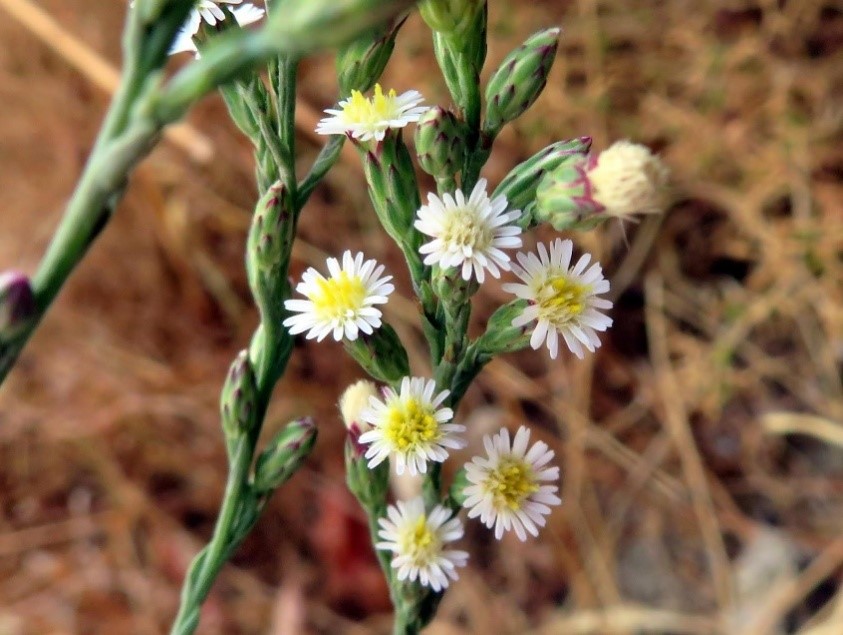
Baby's breath aster, Annual Aster, Blackland aster
Aster subulatus var. australis (A.Gray) Shinners, Aster subulatus var. bahamensis (Britton) Bosser., Aster subulatus var. cubensis (DC.) Shinners, Aster subulatus var. elongatus A.G.Jones & Lowry, Aster subulatus var. euroauster Fernald & Griscom, Aster subulatus var. ligulatus Shinners, Aster subulatus var. obtusifolius Fernald, Aster subulatus var. sandwicensis (A.Gray) A.G.Jones, Aster subulatus var. subulatus (TPL, 2020).
Its origin is America. It is a plant with a highly branched stem, mostly purplish in color and can grow up to 150 cm in length. It can invade agricultural ecosystems with very different qualities such as field crops, meadow and pasture areas, orchards and vineyard areas. In addition to agricultural areas, Cheeky pat grass prefers moist soil and debris areas such as stream beds, canals, rivers, roads, railroad edges, empty, debris areas and forest openings as habitats, and spreads up to 900 - 2300 (-2750) meters in its natural areas. It grows better in pine-oak forests, deciduous forests, grasslands and salt marshes (McVaugh, 1984; Karaer et al., 2015). In Turkey, it is distributed in the Black Sea, Marmara, Aegean and Mediterranean regions. Due to its high vegetative reproductive ability, it can cause significant problems in both agricultural and non-agricultural areas. In addition to its high ecological tolerance, it can be much more competitive especially in humid areas.
Type Description
Its origin is America. The stem is highly branched, the stem is mostly purplish in color and can grow up to 150 cm in length. The edges of the spirally arranged leaves are wavy or serrated. The flower spike (capitula) with a diameter of 5-7 mm forms clusters of up to 120 in number. The upper part of the capitula is broadly cylindrical. The capitula leaflets (fillaria) are 4-8 (-17), superimposed on each other like tiles, in 3 rows, each row different in length and narrowing towards the tip. Outermost phyllaries are short, 2-3 mm, curved back when the flower matures together with the middle ones, inner phyllaries are narrow, rectangular, 5-6 mm, green along the midrib, purplish on the terminal margins and membranous on the lateral margins (Karaer et al., 2015). Life form is herbaceous.
Habitat
It can invade agricultural ecosystems with very different characteristics such as field crops, meadow and pasture areas, orchards and vineyard areas. In addition to agricultural areas, Cheeky popweed prefers moist soil and debris areas such as stream beds, canals, rivers, roads, railroad edges, vacant, debris areas and forest openings as habitats and spreads up to 900 - 2300 (-2750) meters in its natural areas. It grows better in pine-oak forests, deciduous forests, grasslands and salt marshes (McVaugh, 1984; Karaer et al., 2015). In Turkey, it is distributed in the Black Sea, Marmara, Aegean and Mediterranean regions. It has been recorded as an invasive species in Africa and its neighboring islands, Asia, especially the Middle East and Turkey, Japan, Australia, New Zealand, Europe and the Caucasus (Nesom, 2005).
Reproductive Information
Lifecycle
Nutrition Information
General Impact Information
Due to its high vegetative reproductive ability, it can pose significant problems in both agricultural and non-agricultural areas. In addition to its high ecological tolerance, it can be much more competitive especially in humid areas. In case of high infestation in meadow and pasture areas, it can seriously affect the use of these areas. In addition, since it spreads horizontally in the lower and upper layers of the soil and completely covers the area, it prevents the development of superficial rooted plants (wheatgrasses, etc.) and natural tree and shrub species in terms of soil moisture (Karaer et al., 2015).
General Management Information
Although the distribution of the species in Turkey is generally at low altitudes, the fact that it can spread above 2000 m in its natural habitat suggests that its vertical distribution may continue towards higher altitudes in our country.
General Pathway Information
"It reaches and settles in vacant areas when the land is left empty during tillage. Especially saline areas and salty areas caused by salinization of highways are ideal areas for this species. Thus, they can form large populations in the areas where they are found. In addition, the species, which can spread much farther with its achene-type fruits, can also spread by water and animals (Terzioğlu and Anşin, 2001; Karaer et al., 2015).
Although the route of entry of the species into our country is not known for certain, it is considered that the possible vectors in our country are human activities, animals, wind and water. Considering the terminology used in the international arena, it was evaluated that it entered our country both unknowingly (human activities) and naturally (animals, water and wind)."
Notes
Although the distribution of the species in Turkey is generally at low altitudes, the fact that it can spread above 2000 m in its natural habitat suggests that its vertical distribution may continue towards higher altitudes in our country.
References
LOCATIONS
Seas or cities with distribution records for Baby's breath aster, Annual Aster, Blackland aster
IMPACT INFORMATION
Yüksek vejetatif üreme yeteneği nedeniyle hem tarım hem de tarım dışı alanlarda önemli sorunlar oluşturabilmektedir. Ekolojik toleransı yüksek olmasının yanında, özellikle nemli alanlarda çok daha rekabetçi olabilmektedir. Çayır ve mera alanlarında istilanın yüksek olması durumunda bu alanların kullanımını ciddi ölçüde etkileyebilmektedir. Ayrıca toprağın alt ve üst tabakasında yatay olarak yayıldığı ve alanı tamamen kapladığı için toprak nemi açısından yüzeysel köklü bitkiler (buğdaygiller vb.) ile doğal ağaç ve çalı türlerinin gelişimine engel olmaktadır (Karaer ve ark., 2015).
MANAGEMENT INFORMATION
Although the distribution of the species in Turkey is generally at low altitudes, the fact that it can spread above 2000 m in its natural habitat suggests that its vertical distribution may continue towards higher altitudes in our country.