 Advanced Search
 Map View
 About Us
 News
News
 Contact
 Bildirimde Bulun






 Login
Login

Data and Information System


Invasive Species Details
Tree of Heaven, Chinasumac, Copaltree, Varnishtree
| Kingdom | Phylum | Class | Order | Family | Genus and species |
|---|---|---|---|---|---|
| Plantae | Spermatophyta | Dicotyledonae | Rutales | Simaroubaceae | Ailanthus altissima L. |
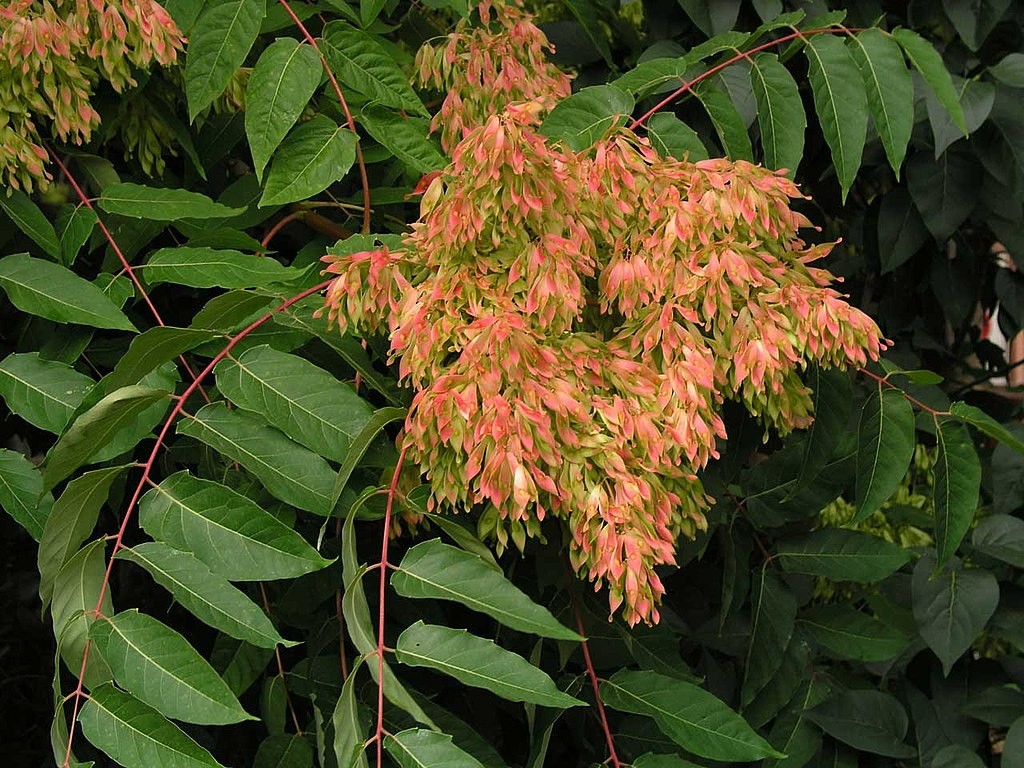
Tree of Heaven, Chinasumac, Copaltree, Varnishtree
Ailanthus altissima var. erythrocarpa (Carrière) Rehder, Ailanthus altissima f. erythrocarpa (Carrière) Rehder, Ailanthus altissima f. erythrocarpa (Carrière) Rehder, Ailanthus altissima var. leucoxyla B.C.Ding & T.B.Chao, Ailanthus altissima var. microphylla B.C.Ding & T.B.Chao, Ailanthus altissima var. pendulifolia (Dippel) Rehder, Ailanthus altissima f. pendulifolia (Dippel) Rehder, Ailanthus altissima var. ramosissima B.C.Ding & T.B.Chao, Ailanthus altissima f. rubra (H.Jaeger) Geerinck, Ailanthus cacodendron (Ehrh.) Schinz & Thell., Ailanthus erythrocarpa Carrière, Ailanthus esquirolii H.Lév., Ailanthus giraldii var. duclouxii Dode, Ailanthus glandulosa Desf., Ailanthus glandulosa var. erythocarpa (Carrière) Mouill., Ailanthus glandulosa f. erythocarpa (Carrière) C.K.Schneid., Ailanthus glandulosa f. pendulifolia Dippel, Ailanthus glandulosa var. pendulifolia (Dippel) Carrière ex Rehder, Ailanthus glandulosa f. rubra (H.Jaeger) Dippel, Ailanthus glandulosa var. spinosa M.Vilm. & Boiss., Ailanthus glandul
It originates from North and Central China, Taiwan and Korea. It is a deciduous tree that sheds its leaves in winter and grows up to 30 m in height. It prefers moist and calcareous soils but is very tolerant of soil type and acidity. Drought tolerant but not tolerant of stagnant water and excessive shade. It is found in forest interiors, parks, roadsides, residential areas, tea plantations and other agricultural areas, railways and highways, and along creeks. It can spread at elevations above 2000 m above the coast. Life form is tree.
Type Description
It originates from North and Central China, Taiwan and Korea. It is deciduous in winter and grows up to 30 m in height. Single pubescent compound leaves can reach 90 cm. The leaflets are hairy or bare. The lowest leaflet has a large pouch and a blunt tooth. The ovate pointed leaflets can grow up to 25 cm long. The first leaves are bronze in color. At the base of the leaflet, which is mostly lobed, there are 1-3 pairs of teeth with glandular sacs and the leaflets are full-margined. The small yellow flowers form a large compound raceme. The plant is dioecious. Fruits are of the winged nus (samara) type and the fruit wing is curved (Davis, 1965-1988; Anşin and Özkan, 1993; Chun, 2006; Uludağ, 2015).
Habitat
It is distributed in all regions of our country. It is naturalized in large areas in America, Europe, Asia, Africa and Australia (Uludağ, 2015).
Reproductive Information
Lifecycle
Nutrition Information
General Impact Information
While it causes serious damage to natural plant taxa in the ecosystems it enters, especially nutrients and shading, it can also cause irreversible damage with the changes it creates in the soil structure. It can cause serious yield losses in agricultural and afforestation areas. Its water consumption, especially in arid ecosystems, and the fact that it is very difficult to eradicate in infected ecosystems make its damage even more important.
General Management Information
General Pathway Information
Although its introduction into new ecosystems is considered to be mainly due to human influence, it can spread quite rapidly thanks to its seeds, which it produces in large quantities, winged nus fruits with curved wings and can easily reach long distances, especially thanks to the wind. On the other hand, its ability to produce strong root and stump shoots and its cultivation due to its high caloric wood can be listed as vectors that increase the spread of the plant. In case the natural cover of the soil is disturbed by various means, it can show itself as a pioneer tree in the area and become invasive. Although the entry route of the species into our country is not known for certain, its fruits are the most likely vectors. The fruits of the species are of the samara type with twisted wings that can be transported easily and over long distances by wind. Considering the terminology used internationally, it was evaluated that it entered our country both intentionally (human) and naturally (wind).
Notes
While its valuable wood is used in furniture, it is also used as fuel due to its high calorific value. On the other hand, its resistance to weather conditions makes it suitable for outdoor use. Despite its odor, its leaves are used in China for breeding a kind of silkworm. Due to its austerity, it is especially suitable for afforestation of sloping and soil-poor areas subject to erosion. Although its wood can be used both in furniture and as fuel due to its high calorific value (Anşin and Özkan, 1993), it is not currently utilized in the furniture industry in our country.
References
LOCATIONS
Seas or cities with distribution records for Tree of Heaven, Chinasumac, Copaltree, Varnishtree
| Name | Description | # | |
|---|---|---|---|
| 1 | Afyonkarahisar | Detail |
| Name | Description | # | |
|---|---|---|---|
| 1 | Diyarbakır | Detail |
| Name | Description | # | |
|---|---|---|---|
| 1 | Kırklareli | Detail |
| Name | Description | # | |
|---|---|---|---|
| 1 | Kahramanmaraş | Detail |
IMPACT INFORMATION
Girdiği ekosistemlerdeki doğal bitki taksonları üzerinde başta besin ve gölgeleme olmak üzere ciddi zararlar oluştururken, toprak yapısında oluşturduğu değişimlerle de çoğu zaman geri dönüşü çok zor zararlara neden olabilmektedir. Tarım alanlarında ve ağaçlandırma sahalarında çok ciddi verim kayıplarına neden olabilmektedir. Özellikle kurak ekosistemlerdeki su tüketimi ve bulaştığı ekosistemlerde eradikasyonunun hayli zor oluşu zararını daha da önemli kılmaktadır.
-
Adana
-
Adıyaman
-
Afyonkarahisar
-
Ağrı
-
Amasya
-
Ankara
-
Antalya
-
Artvin
-
Aydın
-
Balıkesir
-
Bilecik
-
Bingöl
-
Bitlis
-
Bolu
-
Burdur
-
Bursa
-
Çanakkale
-
Çankırı
-
Çorum
-
Denizli
-
Diyarbakır
-
Edirne
-
Elazığ
-
Erzincan
-
Erzurum
-
Eskişehir
-
Gaziantep
-
Giresun
-
Gümüşhane
-
Hakkari
-
Hatay
-
Isparta
-
Mersin
-
İstanbul
-
İzmir
-
Kars
-
Kastamonu
-
Kayseri
-
Kırklareli
-
Kırşehir
-
Kocaeli
-
Konya
-
Kütahya
-
Malatya
-
Manisa
-
Kahramanmaraş
-
Mardin
-
Muğla
-
Muş
-
Nevşehir
-
Niğde
-
Ordu
-
Rize
-
Sakarya
-
Samsun
-
Siirt
-
Sinop
-
Sivas
-
Tekirdağ
-
Tokat
-
Trabzon
-
Tunceli
-
Şanlıurfa
-
Uşak
-
Van
-
Yozgat
-
Zonguldak
-
Aksaray
-
Bayburt
-
Karaman
-
Kırıkkale
-
Batman
-
Şırnak
-
Bartın
-
Ardahan
-
Iğdır
-
Yalova
-
Karabük
-
Kilis
-
Osmaniye
-
Düzce
- Modification of hydrology/water regulation, purification and quality /soil moisture
MANAGEMENT INFORMATION