 Advanced Search
 Map View
 About Us
 News
News
 Contact
 Bildirimde Bulun






 Login
Login

Data and Information System


Invasive Species Details
"Rose-ringed Parakeet Ring-necked Parakeet "
| Kingdom | Phylum | Class | Order | Family | Genus and species |
|---|---|---|---|---|---|
| Animalia | Chordata | Aves | Psittaciformes | Psittaculidae | Psittacula krameri |
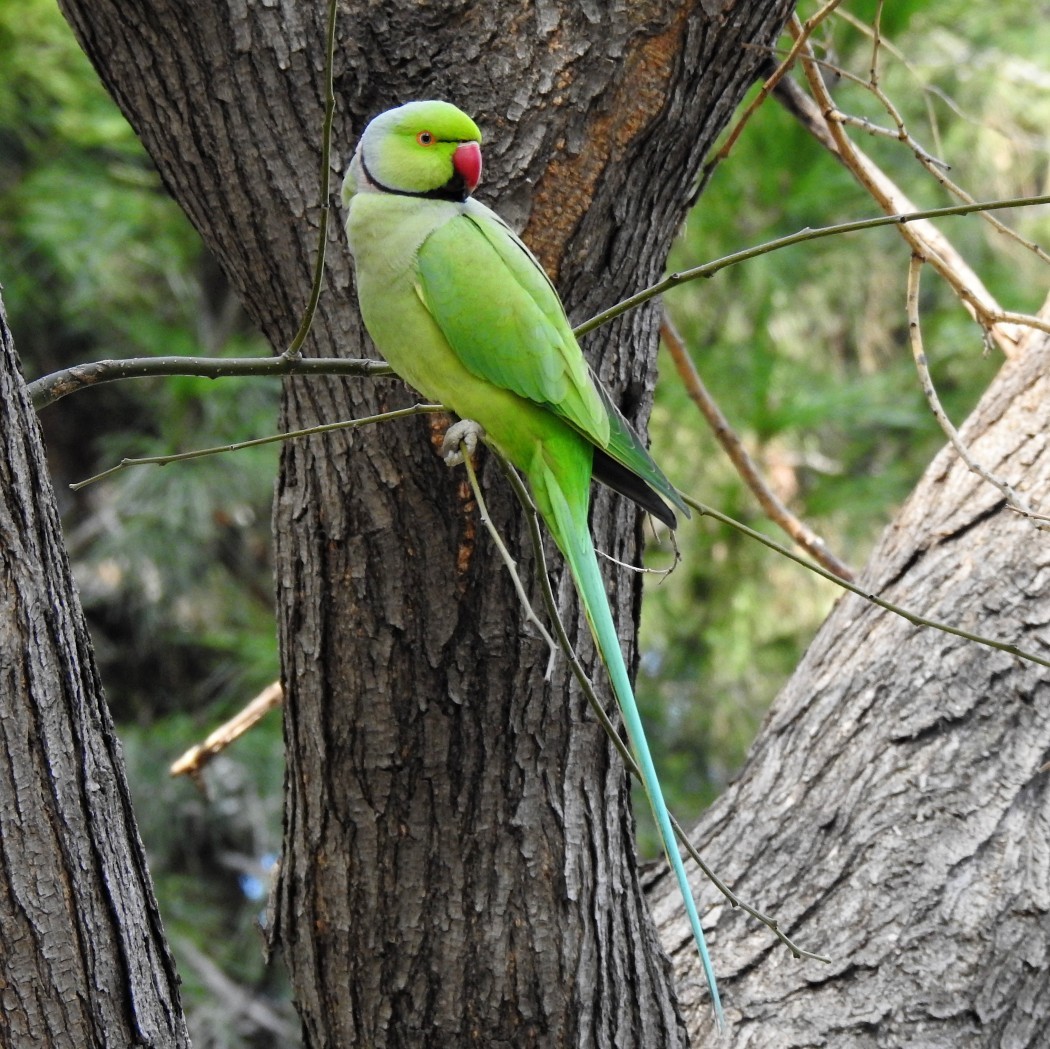
"Rose-ringed Parakeet Ring-necked Parakeet "
" ALT TÜRLERİ (SİNONİM DEĞİL!) Psittacula krameri krameri (Scopoli, 1769) Psittacula krameri parvirostris (Souancé, 1856) Psittacula krameri borealis (Neumann, 1915) Psittacula krameri manillensis (Bechstein, 1800) "
The length is 37-43 cm (beak to tail tip), wingspan is 42-48 cm, and weight is 95-143 grams. The body of the Rose-ringed Parakeet is a bright emerald green. Rose-ringed Parakeets are a species that can be found in a variety of habitats such as riparian forests, mangroves, savannas, grasslands, open farmland, scattered woodlands, urban parks, and gardens. In the areas it has invaded, it is generally found in parks and gardens in cities. They have been observed at altitudes of up to 1600 meters in Asia and around 2000 meters in Ethiopia. Anny et al. (2009) stated that Rose-ringed Parakeets in Belgium can also live outside the city when they find suitable food sources and sufficient nesting cavities, especially when there is no excessive icing. They molt twice, before and after breeding, but they do not lose their ability to fly during this stage. They are not migratory.
Type Description
"It is 37-43 cm in length (from beak to tail tip), with a wingspan of 42-48 cm and weighs 95-143 grams. The body of the Rose-ringed Parakeet is shiny emerald green. The central tail feathers of the long, green tail are bluish, and the tail tips are greenish-yellow. The underwing coverts are yellowish-green. Its large upper beak is hook-like, red, with a dark tip, while the lower beak is black. Its legs are greenish-gray. In males, a black collar extends from the gape toward the nape in a crescent shape. The collar is bordered below by pale pink and above by blue; the blue sometimes extends toward the back of the head. There is a very thin black line at the eye margin, and the eyes are blue. Females do not have the patterning on the head, although some may have an indistinct black line at the eye margin. Juveniles resemble females but are more yellowish, and the collar may be absent or quite faint. The collar in males appears at the age of 3. It can be confused with the Alexandrine Parakeet; however, it differs from it by the absence of pink on the shoulder and the black lower beak. It lives and nests in hollows of large trees in parks. Its main diet consists of fruits, seeds, nuts, and vegetables. Its native range is Africa and India, and it is a species of escaped caged birds seen in city parks in our country.
Variations:
P. k. krameri: The bird described above. Distribution: Southern Mauritania, Senegal, and eastern South Sudan, northern Uganda.
P. k. parvirostris: The head and cheeks are less yellow than in the nominate subspecies. Its beak is smaller, and the upper beak is bright red with a less dark tip. Distribution: Central and Eastern Sudan, Eastern Ethiopia, Eritrea, and Djibouti.
P. k. borealis: It is larger than the nominate subspecies. The upper beak is entirely red, and there are black spots on the lower beak. Distribution: Northeast Afghanistan, northern and eastern Pakistan, India, Nepal, Bangladesh, Myanmar, and possibly southern China.
P. k. manillensis: It is larger than other subspecies. It is paler and more yellowish than borealis; the lower beak is black. Distribution: Indian Peninsula and Sri Lanka, below the 20th parallel north."
Habitat
"Rose-ringed Parakeets are a species that can be found in a variety of habitats, including riparian forests, mangroves, savannas, grasslands, open agricultural areas, scattered woodlands, urban parks, and gardens. In invaded areas, they are commonly found in parks and gardens in cities. They have been observed at altitudes of up to 1600 meters in Asia and approximately 2000 meters in Ethiopia. Anny et al. (2009) stated thatRose-ringed Parakeets can also live outside of cities when they find suitable food sources and sufficient nesting cavities, and when extreme icing is not observed, in Belgium.
The trees they choose as nesting sites are recorded as London Plane (Platanus x acerifolia), Stone pine (Pinus pinea), Silver lime (Tilia argentea), Trembling aspen (Populus tremula), Japanese pagoda tree (Sophora japonica), and English oak (Quercus robur).
Rose-ringed Parakeets are naturally distributed in Sub-Saharan Africa and India. Afghanistan, Bangladesh, Benin, Bhutan, Burkina Faso, Cameroon, Central African Republic, Chad, China, Ivory Coast, Djibouti, Eritrea, Ethiopia, Gambia, Ghana, Guinea, Guinea-Bissau, India, Liberia, Mali, Mauritania, Myanmar, Nepal, Niger, Nigeria, Pakistan, Senegal, Sierra Leone, South Sudan, Sri Lanka, Sudan, Togo, Uganda, and Vietnam are countries where the Rose-ringed Parakeet is found naturally.
P. k. krameri and P. k. parvirostris are found in Africa, while P. k. borealis and P. k. manillensis are found in India.
In Turkey, records have been reported from a total of 29 different provinces including Adana, Ankara, Antalya, Balıkesir, Bolu, Burdur, Bursa, Çanakkale, Denizli, Eskişehir, Gaziantep, Giresun, Hatay, Istanbul, Izmir, Kastamonu, Kayseri, Kırklareli, Kırşehir, Kocaeli, Muğla, Mersin, Osmaniye, Sakarya, Samsun, Sinop, Tekirdağ, Trabzon, Şanlıurfa, and Yalova. However, Rose-ringed Parakeets have not been able to establish successful populations in all of these areas. Most of the records are limited to one occurrence. Records of breeding have been reported only in Ankara, Antalya, Istanbul, Izmir, Eskişehir, Yalova, and Şanlıurfa.
There is not much direct information available on how Rose-ringed Parakeets escaped into the wild or were intentionally released in many countries. While many explanations are speculative, a large part of them are associated with people's accounts or various reports and newspaper articles. However, it is known that Rose-ringed Parakeets are only kept as cage birds. Well-known as cage birds, Rose-ringed Parakeets have managed to establish natural populations by escaping from cages or being intentionally released by humans in countries they were commercially brought to. Among many cage-traded birds, Rose-ringed Parakeets are considered one of the most successful invaders.
In Belgium, several Rose-ringed Parakeets were released by a zoo (Devillers et al., 1988). In Germany, it is said that a group of Rose-ringed Parakeets was released from Cologne Zoo, while some sources indicate that a seller released 20-30 birds (Kahl-Dunkel & Werner, 2002). In England, it is reported that they were released to roam and breathe fresh air with free-flying pigeons, and in Mauritius, it is stated that the birds escaped from cages (Buxton, 1868; Cramp, 1985). In the United States, it is mentioned that a storm lifted the roof of a building where Rose-ringed Parakeets were, allowing two pairs to escape into the wild (City of Bakersfield, 2009). Dvir (1980) stated that the populations in Israel were introduced from outside, but Hatzofe and Yom-Tov (2002) suggested that the birds may have spread from feral populations in Egypt to Israel.
In Turkey, various theories have been proposed regarding how the naturalization process occurred. Some of these include Rose-ringed Parakeets escaping from a ship passing through the Bosphorus, or being released after a truck overturned, or about 150 birds escaping at Istanbul Airport for trade purposes, or arriving after fleeing from the Gulf War. Although it is unclear which of these reasons is true, it is widely known that birds kept in homes escape from cages, and sometimes birds are released illegally from pet shops. These have created opportunities for Rose-ringed Parakeets to establish populations in the wild.
As a species traded as cage birds, the trade itself constitutes one of the pathways for their spread and the establishment of feral populations. Rose-ringed Parakeets:
- Escape during transportation
- Escape from places such as cages and aviaries, or are released by owners
- Establish feral populations as a result of the spread of established populations.
It is indicated that in most Arab countries, Rose-ringed Parakeets settle in nature as a result of escaping during transportation. The Arabian Peninsula is an important stopover point for ships bringing birds from India. It is stated that during these stopovers and transfers, a significant number of parakeets escaped from cages. Today, birds captured from their wild habitats are still transported for trade purposes, providing opportunities for them to escape during this process.
The escape of birds from cages or their release by owners are significant factors supporting the establishment of new feral populations. Although it is unknown where most populations came from, repeated releases or escapes contribute to their spread into unnatural habitats. In the 1970s, zoos released Rose-ringed Parakeets to attract visitors and increase visitor numbers. Nowadays, due to the recognition of invasive alien species concept, such practices are considered very limited. However, in 2005, a zoo in the Netherlands released Monk parakeets repeatedly, but due to complaints, they caught them and decided not to release them again.
The spread of established populations resulting in the emergence of new populations has only facilitated the emergence of new Rose-ringed Parakeet populations. Breeding bird atlas studies conducted in the 1960s in the UK, Germany, and Spain show that established populations are gradually spreading when compared with current data. Strubbe and Matthysen (2009) stated, through their ecological niche modeling studies, that there is more suitable habitat in Belgium where the species could distribute, and over time, the species could spread more widely."
Reproductive Information
"Rose-ringed Parakeets reach sexual maturity at the age of 3. However, it has been observed that subadults can breed before reaching the age of 3 in the UK and Belgium.
The breeding season occurs from August to November in Africa, while in India, it ranges from December to May. In Israel, the UK, and similar areas, the breeding season varies from February to May.
They nest in tree hollows, typically excavating the hollows themselves. Occasionally, they have been recorded nesting in ruined buildings' walls or rocky cliffs. Nests are usually located 3-10 meters above ground level.
Clutch size ranges from 3 to 4 eggs, with rare instances of 6 eggs being recorded. The dimensions of eggs in captive birds are recorded as 29–31 mm × 21·5–22·1 mm. The incubation period is 22 days, and the fledglings leave the nest approximately 7 weeks after hatching. In the UK, the average clutch size is 3.7 eggs, and the nestling period is approximately 49 days. A breeding success rate of 72% has been observed in nests in the UK, with an average of 1.4 fledglings per nest.
In Belgium, since Rose-ringed Parakeets start breeding in February, which is earlier than native species, they have the potential to displace other cavity-nesting species.
While clutch size remains consistent between native populations in India and non-native populations in the UK and Israel, significant differences in breeding success have been observed. In India, the primary causes of chick mortality are predators, whereas in invaded countries, there are no predators. However, in the UK, the low breeding success is attributed to the failure of eggs to hatch, likely due to lower temperatures compared to Israel and India.
Yeşil papağanın üreme parametreleri (ortalama ± standart sapma)
India (native species) UK (invasive species) Israel (invasive species)
Incubation size: 3.83 ± 0.07 3.75 ± 0.13. 4.05 ± 0.18
Number of chicks: 3.11 ± 0.20 1.87 ± 0.15 3.35 ± 0.23
Number of fledged chicks: 2.59 ± 0.24 1.40 ± 0.12 2.25 ± 0.20
"
Lifecycle
"The breeding season of the Rose-ringed Parakeet varies across different regions. In Africa, it typically occurs between August and November, while in India, it spans from December to May. In areas like Israel and England, there are variations, with breeding occurring between February and May.
The Rose-ringed Parakeet undergoes two molting periods, one before breeding and another after. However, it doesn't lose its ability to fly during these stages. Unlike migratory birds, it does not migrate."
Nutrition Information
"In Africa, it is generally fed with fig, jujube, tamarind, guava, date, mango, baobab fruits, acacia seeds, coffee, lentils, sorghum and forage plant seeds from cultivated plants.
In Asia, seeds of Prosopis spicigera, Acacia arabica, Casuarina equisetifolia plants, Dalbergia sissoo, Ficus, Acacia, Ziziphus, Xanthium, Melia azedarach, Azadirachta indica and Albizia lebbek, Capparis aphylla flowers, Salmalia malabarica, Erythrina indica, Butea monosperma, Bassia latifolia plants It feeds on petals and nectar.
Invasive Rose-ringed Parakeets found in England feed on Rosaceae, Ilex, Sambucus fruits, Fagus, Aesculus, Carpinus, Fraxinus, Pinus nuts and fruits of cultivated plants.
In Turkey, so far Platanus orientalis, Styphnolobium japonicum, Acer, Ulmus, Celtis australis, Cupressus, Juglans regia, Malus, Pinus nigra, Ligustrum japonicum, Diospyros kaki, Punica granatum, Cedrus libani, Prunus avium, Pyracantha coccinea, Malus floribunda It has been observed that they feed on the fruits and seeds of Olea europaea, Pistacia terebinthus plants.
The species, which is considered the most effective agricultural pest in Asia, is known to come to Citrus and Prunus orchards in large flocks. It has been reported that they eat corn in September-December, ground-grown nuts in November-March and May-June, and grains in March. They have been observed trying to tear apart sacks to reach coffee, sunflowers, peppers and chickpeas.
It has been noted that they frequently visit feeders used for bird feeding in some European countries, especially England.
Rose-ringed Parakeets can fly up to 15 km between their roosting areas and feeding areas on a daily basis. Aggressive behavior towards both their own species and other species has been observed while feeding."
General Impact Information
"Economic Impact: While only a few reports mention the species causing damage to agricultural products in Africa, the Rose-ringed Parakeet is considered the most damaging agricultural pest to crops in Asia. It has been found to feed on agricultural products such as corn, mustard, rice, sunflower, almond, date, guava, peach, papaya, sorghum, sesame, wheat, barley, grapes, and pomegranate. Khan et al. (2004) stated that the Rose-ringed Parakeet benefits from agricultural development in Asia. Initially covered with tropical thorn forests, the Central Punjab region has seen the introduction of some non-native large trees and increased agricultural activities over time, allowing birds to settle there and nest in those large trees. It is considered invasive in most of its established locations.
From the regions where it is an alien species, it has only been reported to cause damage to vineyards in England (Butler, 2003). The extent of the damage is reported to reduce the yield from 5000 bottles of wine to 3000 bottles.
Ecological Impact: In Europe, it is known that Rose-ringed Parakeets compete with other species for nesting cavities. Rose-ringed Parakeets are listed among the worst 100 species invading Europe (DAISIE, 2009). Although many sources state that the species competes with native species or agricultural pests, there is very little research on the subject, and most explanations are speculative (White et al., 2019). In a study conducted in Belgium where the actual impact on native species was revealed, it was found that Rose-ringed Parakeets compete with Eurasian nuthatches (Sitta europaea) for nesting cavities (Strubbe and Matthysen, 2007). Another competition was recorded with a bat species (Nyctalus lasiopterus) breeding in Spain. Here, it was stated that Rose-ringed Parakeets significantly reduced the population size of the bat species, putting the species at risk. Although their effects are not fully understood, interactions with various species such as squirrels, sparrows, carrion crows, silver gulls, and jackdaws have been observed.
Finding nesting sites can sometimes be challenging for species that nest in cavities. Therefore, competition among Rose-ringed Parakeets in areas where they are abundant or will be abundant is possible, although not yet confirmed by other countries. In England, since the species is reported to cause damage to agricultural products, it is also considered an invasive alien species there (Butler, 2003).
Social Impact: Public interest in Rose-ringed Parakeets is generally positive. Many people express that Rose-ringed Parakeets bring color to the city and parks. Very few people are bothered by their noise. Especially those who share the same environment continuously (park keepers, vendors, etc.) express discomfort from the noise generated by large groups. On the other hand, some people express concerns about the potential harmful effects on native birds or other animals if the population size of Rose-ringed Parakeets were to increase."
General Management Information
"As with many invasive species, rapid detection significantly prevents the spread of the species in the country. When Rose-ringed Parakeet groups are first detected, a rapid response is recommended: the birds should be captured as quickly as possible, and dispersal to create new populations should be prevented.
People and the public need to be better and more comprehensively informed about the potential impacts of the species, and public awareness needs to be raised. Since forming a negative view for a charismatic and beloved species like the Rose-ringed Parakeet would be quite problematic, more delicate approaches should be taken.
If the population is small, eradication will be cost-effective. However, in large and widespread populations, the likelihood of successful eradication is quite low. Rose-ringed Parakeets form large flocks and gather together in roosts in the evenings. This provides a good opportunity to deal with large flocks. However, caution must be exercised. Disturbing the roosting area may cause them to abandon their roost.
Rose-ringed Parakeets, especially in European countries, benefit from the food provided by humans. Reducing or eliminating these food sources can be used to limit the number of the species. However, this situation is not applicable in Turkey. There are plenty of crops available for Rose-ringed Parakeets to feed on in urban areas.
Capturing the species can be a good solution for eradication. However, shooting is not a feasible solution due to the presence of the species in urban areas."
General Pathway Information
"The species is one of the commonly traded species, intentionally brought as cage birds to many countries. According to CITES records, the Rose-ringed Parakeet has been officially traded as a cage bird in our country since 1991. Its sale as a cage bird is quite common. Although official records indicate its first entry into the country in 1991, the Rose-ringed Parakeet was first recorded in Ankara in 1975. Subsequently, it was observed in Mersin in 1990 and in Istanbul in 1991. The most serious claims regarding the reasons for its occurrence in the wild are related to accidents such as the overturning of trucks carrying Rose-ringed Parakeets, resulting in the birds escaping from their cages and becoming free, and the birds escaping from the customs area at Atatürk Airport. However, it is also known that Rose-ringed Parakeet owners sometimes release their birds into the wild when they are unable to take care of them. Similarly, like other cage-traded birds, there are still Rose-ringed Parakeets that accidentally escape from pet shops. Therefore, the entry route of Rose-ringed Parakeets that have been able to establish populations in the wild in Turkey is the intentional or accidental release of this cage-traded bird into nature.
Records have been reported from a total of 30 different provinces in Turkey, including Adana, Ankara, Antalya, Balıkesir, Bolu, Burdur, Bursa, Çanakkale, Denizli, Eskişehir, Gaziantep, Giresun, Hatay, Istanbul, Izmir, Kastamonu, Kayseri, Kırklareli, Kırşehir, Kocaeli, Muğla, Mersin, Osmaniye, Sakarya, Samsun, Sinop, Tekirdağ, Trabzon, Şanlıurfa, and Yalova. However, Rose-ringed Parakeets have not been able to establish successful populations in all of these areas. Most of the records are limited to one occurrence. Records of breeding have been reported only in Ankara, Antalya, Istanbul, Izmir, Eskişehir, Yalova, and Şanlıurfa. Due to its rapidly increasing numbers and distribution, comprehensive studies are needed."
Notes
"They are widely known and popular as cage birds. They are brought to zoos for exhibition and also traded in pet shops.
It has become quite widespread in European countries, including our country. Their numbers are rapidly increasing."
References
LOCATIONS
Seas or cities with distribution records for "Rose-ringed Parakeet Ring-necked Parakeet "
| Name | Description | # | |
|---|---|---|---|
| 1 | Kırklareli | Detail |
IMPACT INFORMATION
"Ekonomik etki: Türün Afrika’da tarımsal ürünlere zarar verdiği sadece birkaç raporda yer almasına rağmen, Yeşil papağan Asya’da tarımsal ürünlere en ağır hasarı veren tarım zararlısı olarak kabul edilmektedir. Mısır, hardal, pirinç, ayçiçeği, badem, hurma, guava, şeftali, papaya, sorgum, susam, buğday, arpa, üzüm ve nar gibi tarımsal ürünlerle beslendiği tespit edilmiştir. Khan ve ark. (2004), Yeşil papağanın Asya’daki tarımsal kalkınmadan faydalandığını ifade etmişlerdir. Orta Punjab bölgesi başlangıçta tropikal diken ormanı ile kaplıyken zamanla oranın doğal türü olmayan bazı büyük ağaçların getirilmesi ve tarımsal faaliyetlerin artması kuşların oraya yerleşmelerine ve o büyük ağaçlarda yuvalar yapmalarına olanak sağlamıştır. Yerleşik olduğu çoğu yerde istilacı olarak kabul edilmektedir.
Yabancı tür olduğu bölgelerden sadece İngiltere’de üzüm bağlarına zarar verdiği rapor edilmiştir (Butler, 2003). Verdiği zararın boyutu, verimi 5000 şişe şaraptan 3000 şişe şaraba düşürmüş olmasıdır.
Ekolojik etki: Avrupa’da Yeşil papağanın yuva kovukları için başka türlerle rekabet ettiği bilinmektedir. Yeşil papağanlar Avrupa’yı istila eden en kötü 100 tür içerisinde listelenmiştir (DAISIE, 2009). Her ne kadar birçok kaynak türün tarım zararlısı ya da yerli türlerle rekabet halinde olduğunu ifade etse de konuyla ilgili çok az çalışma olduğu ve çoğu açıklamaların spekülatif olduğu bilinmektedir (White ve ark., 2019). Gerçek anlamda doğal türler üzerine bir etkisinin ortaya çıkarıldığı Belçika’daki bir çalışmada Yeşil papağanların Sıvacıkuşu (Sitta europaea) ile yuva kovukları için rekabet ettiği tespit edilmiştir (Strubbe ve Matthysen, 2007). Diğer bir rekabet de İspanyada üreyen bir yarasa (Nyctalus lasiopterus) türü ile kaydedilmiştir. Burada yeşil papağanların yarasa türünün popülasyon büyüklüğünü önemli ölçüde düşürdükleri ve türün risk altına girdiği belirtilmiştir. Tam olarak etkileri tespit edilemese de sincap, serçe, leş kargası, gümüş martı, küçük karga gibi çeşitli türlerle etkileşim halinde olduğu gözlenmiştir.
Kovuklarda yuva yapan türler için bazen yuva yeri bulmak sıkıntılı olabilmektedir. Bu nedenle de Yeşil papağanların bol bulunduğu ya da bulunacağı yerlerde rekabet etmesi, henüz başka ülkelerce doğrulanmasa da mümkündür. İngiltere’de ise türün tarımsal ürünlere zarar verdiği rapor edildiğinden orada da istilacı yabancı tür olarak değerlendirilmektedir (Butler, 2003).
Sosyal etki: Halkın Yeşil papağanlara ilgisi genel olarak olumlu. Birçok insan Yeşil papağanların şehre ve parklara renk getirdiğini ifade etmektedir. Çok az kişi sesinden rahatsız olmaktadır. Özellikle sürekli aynı ortamı paylaşmak durumunda kalan insanlar (park bekçileri, satıcılar vb.) büyük grupların çıkardığı seslerden rahatsız olduğunu ifade etmektedir. Diğer taraftan bazı insanlar Yeşil papağanın popülasyon büyüklüğünün artması durumunda yerli kuşlara ya da diğer hayvanlara zararlı etkilerinin olabileceğinden yana kaygı duyduklarını ifade etmektedirler.
"
-
Kırklareli
-
Tekirdağ
-
İstanbul
-
Kocaeli
-
Sakarya
-
Balıkesir
-
Bursa
-
Yalova
-
Çanakkale
-
İzmir
-
Muğla
-
Denizli
-
Burdur
-
Antalya
-
Mersin
-
Adana
-
Osmaniye
-
Hatay
-
Kayseri
-
Gaziantep
-
Şanlıurfa
-
Eskişehir
-
Ankara
-
Bolu
-
Kırşehir
-
Kastamonu
-
Sinop
-
Samsun
-
Giresun
-
Trabzon
- Population size decline
- Damage to agriculture
MANAGEMENT INFORMATION
"As with many invasive species, rapid detection significantly prevents the spread of the species in the country. When Rose-ringed Parakeet groups are first detected, a rapid response is recommended: the birds should be captured as quickly as possible, and dispersal to create new populations should be prevented.
People and the public need to be better and more comprehensively informed about the potential impacts of the species, and public awareness needs to be raised. Since forming a negative view for a charismatic and beloved species like the Rose-ringed Parakeet would be quite problematic, more delicate approaches should be taken.
If the population is small, eradication will be cost-effective. However, in large and widespread populations, the likelihood of successful eradication is quite low. Rose-ringed Parakeets form large flocks and gather together in roosts in the evenings. This provides a good opportunity to deal with large flocks. However, caution must be exercised. Disturbing the roosting area may cause them to abandon their roost.
Rose-ringed Parakeets, especially in European countries, benefit from the food provided by humans. Reducing or eliminating these food sources can be used to limit the number of the species. However, this situation is not applicable in Turkey. There are plenty of crops available for Rose-ringed Parakeets to feed on in urban areas.
Capturing the species can be a good solution for eradication. However, shooting is not a feasible solution due to the presence of the species in urban areas."
-
Kırklareli
-
Tekirdağ
-
İstanbul
-
Kocaeli
-
Sakarya
-
Balıkesir
-
Bursa
-
Yalova
-
Çanakkale
-
İzmir
-
Muğla
-
Denizli
-
Burdur
-
Antalya
-
Mersin
-
Adana
-
Osmaniye
-
Hatay
-
Kayseri
-
Gaziantep
-
Şanlıurfa
-
Eskişehir
-
Ankara
-
Bolu
-
Kırşehir
-
Kastamonu
-
Sinop
-
Samsun
-
Giresun
-
Trabzon