 Advanced Search
 Map View
 About Us
 News
News
 Contact
 Bildirimde Bulun






 Login
Login

Data and Information System


Invasive Species Details
Common cocklebur, Clotbur; Cocklebur; Ditchbur
| Kingdom | Phylum | Class | Order | Family | Genus and species |
|---|---|---|---|---|---|
| Plantae | Spermatophyta | Dicotyledonae | Asterales | Asteraceae | Xanthium strumarium L. |
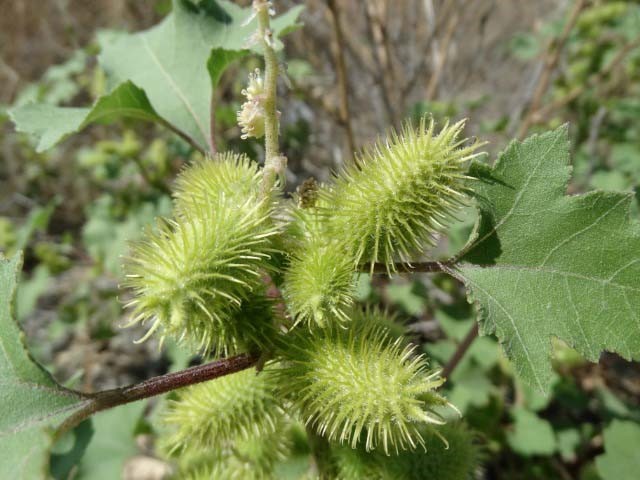
Common cocklebur, Clotbur; Cocklebur; Ditchbur
Xanthium strumarium var. arenarium (Lasch) Uechtritz (TPL, 2020).
"Originating from North America, this plant has taprooted stems that can grow up to 15-80 cm, branching without thorns, and covered with either hairy or smooth textures. While predominantly found in temperate regions, it is also encountered in subtropical and tropical climates (Holm et al., 1991). It spreads across various habitats such as agricultural fields, coastlines, marshes, meadows, forests, and non-agricultural areas. Its presence has been reported in many provinces of Turkey, including Istanbul, Bolu, Adapazari, Kastamonu, Kutahya, Samsun, Izmir, Manisa, Ankara, Erzurum, Van, Sanliurfa, Elazig, Diyarbakir, Denizli, Antalya, Adana, and Mardin, among others (Davis et al., 1975).
It causes yield losses in important crops such as soybeans, cotton, corn, sunflowers, and peanuts (Webster & Coble, 1997). These plants can produce excessive amounts of allergenic pollen (Reddi et al., 1980). Additionally, contact with the glandular hairy structures on the leaves can lead to skin inflammations in sensitive individuals (King, 1966)."
Type Description
Originating from North America, this species is a herbaceous plant with taprooted roots and can grow up to 15-80 cm in height. It is unarmed, branched, and can be either hairy or smooth. The leaves are lanceolate, egg-shaped, irregularly 3-5 lobed, or serrated, covered with short hairs on both sides. Male flowers appear rounded at the top of the plant. Female flower heads, usually with one or two flowers, are found in leaf axils. The fruit is ellipsoid, measuring 12-30 x 8-20 mm, with the upper surface covered with hook-shaped prickles and two horn-like projections at the tip, varying in color from grayish-brown to reddish. It contains two seeds.
Habitat
"In temperate regions, this species is commonly found, but it is also encountered in regions dominated by subtropical and tropical climates (Holm et al., 1991). It spreads in various habitats such as agricultural areas, water edges, marshes, grasslands, forests, and non-agricultural areas. It can grow in different soil types ranging from heavy clay soils to sandy soils. Since it requires ample light, it does not thrive well in shaded areas (Weaver & Lechowicz, 1983). Moreover, it does not perform well in soils poor in nutrients and low in soil moisture. It is observed in areas where crops are grown, coastal areas, riverbanks, railway embankments, road edges, field margins, and open areas (Kaul, 1971). The flowering initiation of this short-day plant, pigweed, is adversely affected by temperatures above 35°C (especially during the dark period) (Lee, 1996). Its seeds require high soil moisture (75%) and temperatures of 20-30°C or 25-33°C for germination (Lee, 1996).
In Turkey, the presence of this plant has been reported in many provinces such as Istanbul, Bolu, Adapazarı, Kastamonu, Kütahya, Samsun, Izmir, Manisa, Ankara, Erzurum, Van, Şanlıurfa, Elazığ, Diyarbakır, Denizli, Antalya, Adana, Mardin, and others (Davis et al., 1975). The plant is of North American origin and is considered to have a homeland extending from the southern part of Canada through the United States to the interior of Mexico, where it is commonly found in corn and soybean fields (Lee, 1996). However, the homeland of pigweed remains uncertain, and research is ongoing due to uncertainties. Love and Dansereau (1959) believe that the native land of this weed is in Central and South America. However, the view that the plant's homeland is North America is more common."
Reproductive Information
Lifecycle
Nutrition Information
General Impact Information
It causes yield losses in areas where important agricultural crops such as soybean, cotton, corn, sunflower, and peanuts are cultivated (Webster & Coble, 1997). Among annual weeds, it is one of the plant species that causes the most yield losses in soybean cultivation in America (Stoller et al., 1987). Similar yield losses have been reported in Canada as well (Weaver, 1991). Besides direct yield losses in soybean, this species also reduces seed quality as a result of competition with soybean plants. It is known that the fruits sticking to the hairs on the legs of animals and the tails and manes of horses disturb the animals. Additionally, it has been reported that cattle and sheep may be poisoned if they consume young plants and seeds while grazing. Furthermore, these plants negatively affect the digestive system of animals and can lead to anemia.
General Management Information
General Pathway Information
"The plant primarily reproduces by seed. Each individual produces an average of 70-600 fruits, and each fruit contains two seeds. In open and suitable habitats, this number can reach up to 2300 fruits per plant. Even dwarf individuals growing in nutrient-poor soils can produce numerous viable seeds (Weaver & Lechowicz, 1983). The fruits, with their hook-shaped spines, facilitate their dispersal over long distances (Roth, 2001). They can be dispersed to large areas and far distances by irrigation waters, rivers, birds, animals, farm implements and machinery, poorly composted farm manure, dry hay bales, or human activities. Therefore, taking preventive measures against spread is crucial. Due to its strong root system, rapid seed germination, relatively large seeds, high seed production, long seed viability, easy seed dispersal, and adaptability to different climatic conditions and habitats, the species has the potential to spread easily to wide areas.
The exact entry route of the species into our country is not known, but it is considered that possible vectors in our country are human activities and animal movements. Considering the terminology used internationally, it is evaluated that the species entered our country both unintentionally (through human activities) and naturally (through animals)."
Notes
"The plant is mentioned to be used as a medicine in the treatment of malaria and for obtaining yellow-colored dye (CABI, 2020).
Plants can produce excessive amounts of allergenic pollen (Reddi et al., 1980). Additionally, it has been noted that contact of the sensitive individuals' skin with the glandular hairy structures on the leaves can cause skin inflammations (King, 1966)."
References
LOCATIONS
Seas or cities with distribution records for Common cocklebur, Clotbur; Cocklebur; Ditchbur
| Name | Description | # | |
|---|---|---|---|
| 1 | Afyonkarahisar | Detail |
| Name | Description | # | |
|---|---|---|---|
| 1 | Diyarbakır | Detail |
| Name | Description | # | |
|---|---|---|---|
| 1 | Kırklareli | Detail |
| Name | Description | # | |
|---|---|---|---|
| 1 | Kahramanmaraş | Detail |
IMPACT INFORMATION
Önemli tarım bitkileri olan soya, pamuk, mısır, ayçiçeği ve yerfıstığı gibi türlerin yetiştirildiği alanlarda verim kaybına sebep olur. (Webster & Coble, 1997). Tek yıllık yabancı otlar içerisinde soya fasulyesinde Amerika’da en fazla verim kaybına neden olan bitki türlerinden biridir (Stoller et al., 1987). Benzer verim kayıpları Kanada da rapor edilmiştir (Weaver, 1991). Bu tür soya fasulyesinde direk verim kayıplarının yanı sıra soyayla rekabeti sonucunda tohum kalitesini de düşürmektedir. Meyvelerinin hayvanların ayaklarındaki kıllara, atların ise kuyruklarına ve yelelerine yapışmasının hayvanları rahatsız ettiği bilinmektedir. Ayrıca sığır ve koyunları otlanma sırasında genç bitkileri ve tohumları yemesi durumunda hayvanların zehirlenebilecekleri belirtilmiştir. Ayrıca bunların hayvanlarda sindirim sistemini olumsuz etkilediği ve kansızlığa neden olabildiği bildirilmektedir.
-
Adana
-
Adıyaman
-
Afyonkarahisar
-
Ağrı
-
Amasya
-
Ankara
-
Antalya
-
Artvin
-
Aydın
-
Balıkesir
-
Bilecik
-
Bingöl
-
Bitlis
-
Bolu
-
Burdur
-
Bursa
-
Çanakkale
-
Çankırı
-
Çorum
-
Denizli
-
Diyarbakır
-
Edirne
-
Elazığ
-
Erzincan
-
Erzurum
-
Eskişehir
-
Gaziantep
-
Giresun
-
Gümüşhane
-
Hakkari
-
Hatay
-
Isparta
-
Mersin
-
İstanbul
-
İzmir
-
Kars
-
Kastamonu
-
Kayseri
-
Kırklareli
-
Kırşehir
-
Kocaeli
-
Konya
-
Kütahya
-
Malatya
-
Manisa
-
Kahramanmaraş
-
Mardin
-
Muğla
-
Muş
-
Nevşehir
-
Niğde
-
Ordu
-
Rize
-
Sakarya
-
Samsun
-
Siirt
-
Sinop
-
Sivas
-
Tekirdağ
-
Tokat
-
Trabzon
-
Tunceli
-
Şanlıurfa
-
Uşak
-
Van
-
Yozgat
-
Zonguldak
-
Aksaray
-
Bayburt
-
Karaman
-
Kırıkkale
-
Batman
-
Şırnak
-
Bartın
-
Ardahan
-
Iğdır
-
Yalova
-
Karabük
-
Kilis
-
Osmaniye
-
Düzce
- Population size decline
MANAGEMENT INFORMATION