 Advanced Search
 Map View
 About Us
 News
News
 Contact
 Bildirimde Bulun






 Login
Login

Data and Information System


Invasive Species Details
Small-leaf spiderwort, Green wandering jew, River spiderwort, Spiderwort, Spider lily, Cradle lily
| Kingdom | Phylum | Class | Order | Family | Genus and species |
|---|---|---|---|---|---|
| Plantae | Spermatophyta | Monocotyledonae | Commelinales | Commelinaceae | Tradescantia fluminensis Vell. |
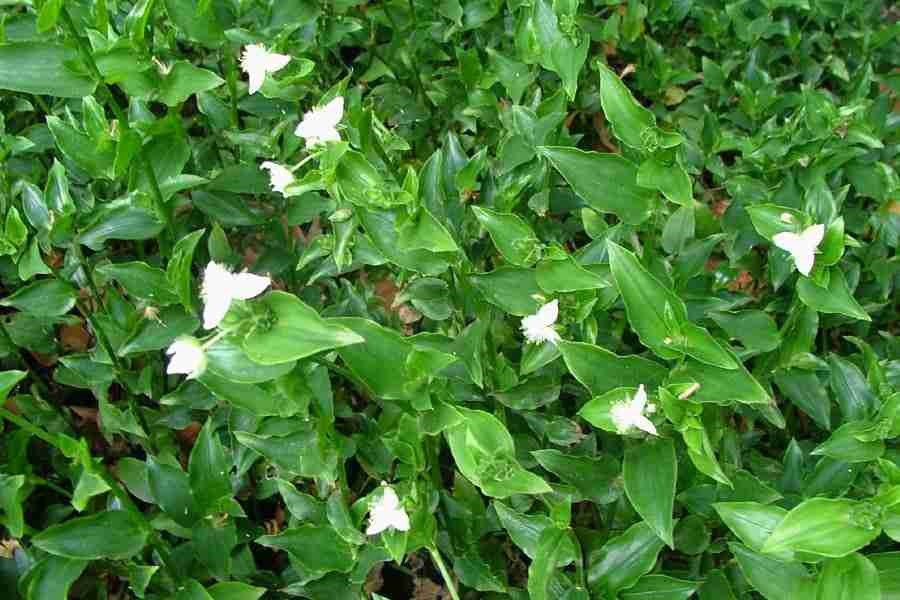
Small-leaf spiderwort, Green wandering jew, River spiderwort, Spiderwort, Spider lily, Cradle lily
Tradescantia fluminensis var. pubescens C.B.Clarke, Tradescantia fluminensis var. tenella (Kunth) C.B.Clarke, Tradescantia fluminensis f. tenella (Kunth) Voss (TPL, 2020).
Originating from America, this species has a soft and fragile structure with a stem length of 1.5 meters and a diameter of 2-3 millimeters. It prefers areas such as roadsides, gardens, riverbanks, wetlands, and shaded areas, especially semi-shaded or lightly sunny, nitrogen-rich, debris areas, riverbeds, and disturbed forest understories, where it thrives rapidly. Known to have been initially cultivated as an ornamental plant in parks and gardens in our country, this species has become naturalized in some regions. Having American origins, this species has spread to continents such as Europe, Africa, Asia, and Australia. Due to its broad ecological tolerance and rapid occupation of space, it tends to shade out ground-level plants, thereby preventing the natural regeneration of taller species. Its dense invasive and ground-covering nature often has adverse effects on biodiversity in forest and riverbank areas. Additionally, it inhibits the arrival of other plants to the areas it occupies. Removing the species from newly colonized areas or completely controlling its spread is extremely difficult.
Type Description
Originating from America, this plant has a stem that can reach up to 1.5 meters in length and is 2-3 mm in diameter, with a soft and fragile structure. The stem also functions as an above-ground creeping stem (stolon), which is smooth, climbing, fleshy, highly branched, and with upward-pointing (erect) branch tips. The leaves are parallel-veined (3-10), spirally arranged, simple, oval-tipped, measuring 1.5-12 x 1-3.5 cm, and either glabrous or slightly hairy. The flowers are white, arranged in clusters, and surrounded by 1-3 bracts that closely resemble the stem leaves. The sepals are oval, 3 in number, measuring 1-2 x 2-5 mm, and hairy, while the petals number 3, measuring 1-2 x 7-10 mm. There are 6 stamens arranged opposite the petals, and the ovary is 3-carpelled with a head-shaped stigma. The fruit is a small 3-part capsule containing 6 seeds with black cavities. Flowering occurs in July, while fruit and seeds ripen from September to November (CABI, 2020; Karaer et al., 2015). This plant has an herbaceous life form.
Habitat
"This plant prefers roadside areas, gardens, riverbanks, wetlands, and shaded areas the most (Standish et al., 2002; Bannister, 1986). It thrives particularly in semi-shaded or lightly sunny locations, nitrogen-rich areas, disturbed sites, riverbeds, and degraded forest understories (Maule et al., 1995). It has a weak tolerance to cold and frost. While it shows the best growth at 10-15°C, it can continue to grow between 18-24°C (Kelly & Skipworth, 1984; Maule et al., 1995). Moist soil is essential for its optimal growth, while snow and especially cold conditions, as well as excessively hot and sunny conditions, can slow down its growth. With its water storage capability, the plant can tolerate drought for a certain period.
The species, originally from America, is known to have been first cultivated as an ornamental plant in parks and gardens in our country (Tan, 1984). In some regions, it has become naturalized. This species is also spreading in continents such as Europe, Africa, Asia, and Australia."
Reproductive Information
Lifecycle
Nutrition Information
General Impact Information
Due to its wide ecological tolerance and rapid growth, this plant tends to shade out ground-level vegetation while preventing the natural regeneration of taller species (Kelly and Skipworth, 1984). Its dense invasive nature and ground-covering ability often have negative impacts on biodiversity in forest and streamside areas (Standish et al., 2001). Additionally, its spread prevents other plants from establishing, leading to homogenization of the invaded habitat and a decrease in species diversity over time (Standish et al., 2001). Chemical control measures for managing this plant can cost up to $1366 for a 2-3 hectare area, with some areas exceeding $4000 per hectare (McCluggage, 1998; Ogle and Lovelock, 1989).
General Management Information
General Pathway Information
"The fact that it is used as an ornamental plant is the most important factor contributing to its rapid spread. Although seed production is relatively weak, its fragile shoots can be transported to new areas by wind, animals, and humans, where they can easily attach and spread, aided by their stolons. Additionally, it can tolerate drought for a certain period due to its water storage capability. Therefore, the plant, which can easily adapt to very different climate and soil conditions, has spread rapidly through vegetative propagation in the areas where it is used as an ornamental plant. The ability to propagate vegetatively in diverse ecological conditions, with shoots growing 2-3 mm daily in summer and 0.4-0.6 mm in winter, resulting in an average annual growth of 60-70 cm, facilitates its rapid spread (Maule et al., 1995). Consequently, the plant quickly covers and spreads in the regions where it is introduced.
The species was introduced to our country as an ornamental plant (ground cover). Taking into account the terminology used internationally, it was intentionally brought to our country (as an ornamental plant)."
Notes
"It is a highly popular and easy-to-care-for indoor ornamental plant. It also has the potential to be used for erosion control on sloping terrain (CABI, 2020).
Removing the species from newly colonized areas or completely controlling its spread is extremely difficult. In our country, it is particularly prevalent in tea gardens and can mix with harvested fresh tea shoots, adversely affecting tea quality. Moreover, uprooting and cleaning the tea plantations is labor-intensive and time-consuming, leading to significant loss of manpower. If left unchecked, its overabundance in an area can alter the nutrient cycle, potentially causing significant problems in newly established forests. The potential for adaptation to very different ecological conditions makes this species a potential risk to biological diversity as well."
References
LOCATIONS
Seas or cities with distribution records for Small-leaf spiderwort, Green wandering jew, River spiderwort, Spiderwort, Spider lily, Cradle lily
IMPACT INFORMATION
Geniş ekolojik hoşgörüsü, hızlı büyüyüp alanı işgal etmesi sebebiyle zemin seviyesindeki bitkileri ışıksız bırakırken, uzun boylu türlerin doğal yenilenmesini önlemektedir (Kelly ve Skipworth, 1984). Yoğun istilacı ve zemin örtme özelliğinden dolayı da genellikle orman ve dere kenarlarındaki biyoçeşitlilik üzerinde olumsuz etkileri bulunmaktadır (Standish et al., 2001). Ayrıca yayıldığı alanlara diğer bitkilerin gelmesi engellenmektedir. Böylece zamanla yeni yerleştiği ortamın homojenleşmesine bu durumda tür çeşitliliğinin azalmasına neden olmaktadır (Standish et al., 2001). Bitkinin kontrolü için yapılan kimyasal mücadele için 2-3 ha büyüklüğündeki bir alanda 1366 dolara ulaşabilmektedir (McCluggage, 1998). Bu rakam hektar başına bazı alanlarda 4000 doların üzerine dahi çıkabilmektedir (Ogle ve Lovelock, 1989).
MANAGEMENT INFORMATION